
About Deputy
Deputy is a Claude Code plugin and MCP server for coding agents, using DeepSeek V4.1 Flash as a lower-cost helper while Claude remains in charge of writing code. It offers code review, second opinions, codebase investigation, and optional task delegation.
Key features
- 01Review code changes for bugs
- 02Get opinions from multiple angles
- 03Find code locations and tests
- 04Delegate specified coding tasks
- 05Track token and cost estimates
Use cases
- 01Check a non-trivial change before completion
- 02Explore a large codebase for a function
- 03Get feedback on an implementation plan
- 04Delegate well-specified mechanical work
MCP support
Deputy exposes review, consult, investigate, delegate, and stats tools through an MCP server. It can be installed in Claude Code and configured for other MCP clients using stdio.
Configuration
Local server config is the same for every client. Copy it into your client’s MCP config file.
uvx deputy-ccDEPUTY_PROVIDERdeepinfra (DeepSeek V4.1 Flash) or xai (Grok, default model grok-4.3).DEEPINFRA_API_KEYSecretDeepInfra API key (deepinfra.com, Dashboard > API Keys), for the default provider. Only sent to api.deepinfra.com.XAI_API_KEYSecretxAI API key (console.x.ai), when DEPUTY_PROVIDER is xai. Only sent to api.x.ai.DEPUTY_MODEaccuracy: Claude writes all code; Deputy reviews and consults. lean: fewest Claude tokens, little accuracy loss. balanced: Deputy takes mechanical work. partner: Deputy does all low-level work and gives ideas. savings: Deputy takes most coding.DEPUTY_THINKINGHow hard the helper model thinks.DEPUTY_MODELModel id served by the endpoint.DEPUTY_BASE_URLAny OpenAI-compatible endpoint (https, or http on localhost for a local model).DEPUTY_WORKSPACEProject folder Deputy may read and edit. Defaults to the client's project folder.DEPUTY_API_KEYSecretAPI key for a non-DeepInfra endpoint. Takes precedence over DEEPINFRA_API_KEY.Local servers need a runtime on your machine (e.g. Node.js 18+). Config file locations differ by client; see your client’s docs.
Tools
6Saved tool list · updated 2d ago
| Parameter | Type | Required | Description |
|---|---|---|---|
| lenses | any | No | |
| context | string | No | |
| my_view | string | No | |
| question | string | Yes | |
| thinking | any | No | |
| project_dir | string | No |
Details
From the project README
Deputy
Deputize cheap models. Claude stays the sheriff.
Deputy is a Claude Code plugin and MCP server that has a cheap model, DeepSeek V4.1 Flash, review Claude's code for bugs and give second opinions, for under a cent each. Claude keeps writing the code.


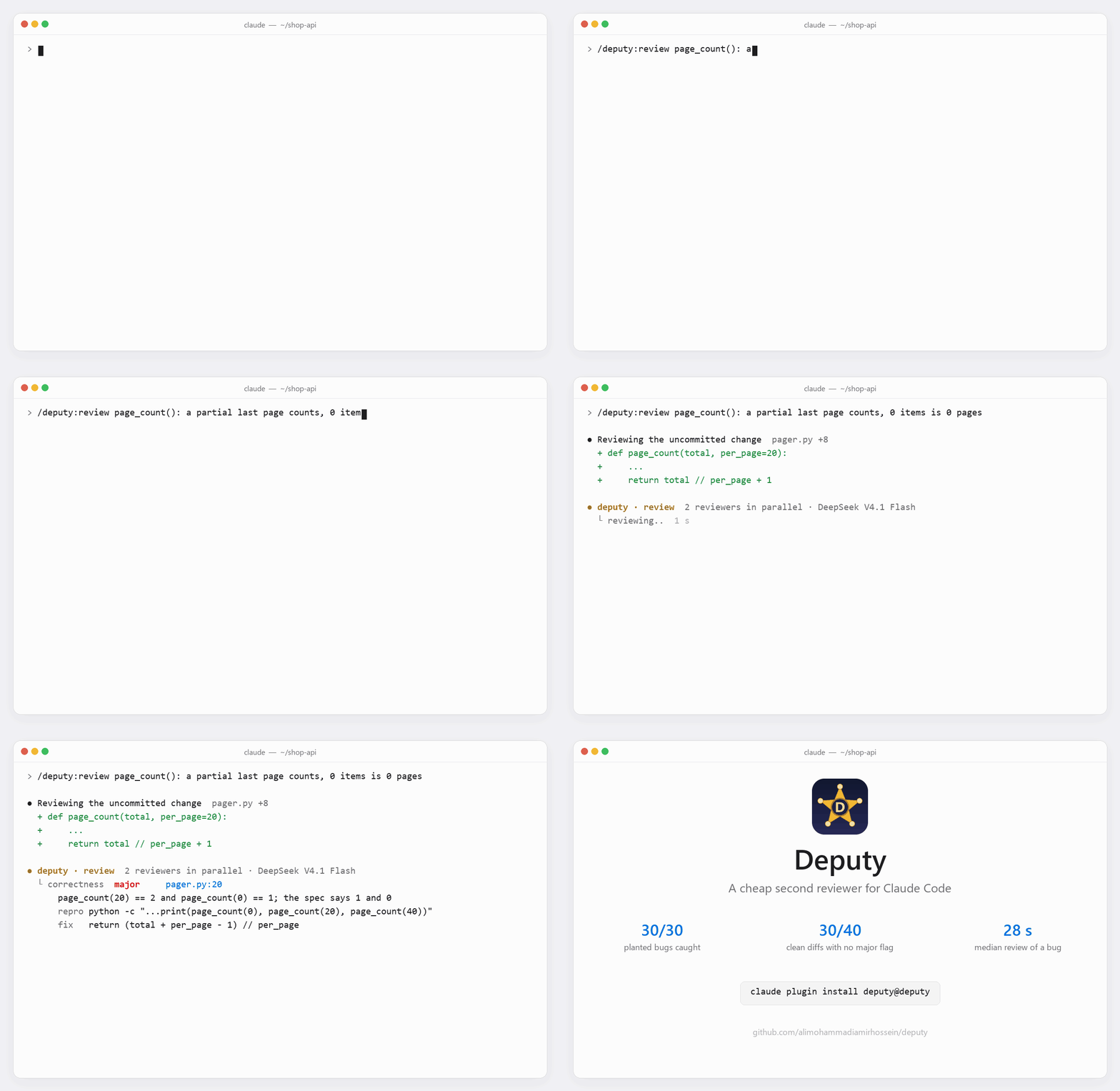
A replay of one benchmark case. Deputy's findings, time and cost, the repro and the test run are real.
claude plugin marketplace add alimohammadiamirhossein/deputy
claude plugin install deputy@deputy
Inside Claude Code the same thing is /plugin marketplace add alimohammadiamirhossein/deputy.
You need uv and a
DeepInfra API key.
What it costs (measured)
| Run | Time | Cost |
|---|---|---|
review: two reviewers check a change with a planted off-by-one bug (both caught it) | 27 s | $0.0011 |
consult: second opinions from 2 angles | 68 s | $0.0018 |
investigate: list a project's functions and their tests | 18 s | $0.0004 |
delegate: fix a bug, add 3 tests, run pytest until green | 46 s | $0.0006 |
Measured on a small demo project with thinking high. On real projects, expect consult and
review to stay under $0.01. Every result shows its real tokens and cost.
Benchmark: Opus with and without Deputy
Four small Python tasks with hidden tests Claude never sees (bench/), one run each on Claude Opus 5.5, October 2026:
| Config | Hidden tests passed | Mean cost (Claude + Deputy) | Median time |
|---|---|---|---|
| Opus alone | 4/4 | $0.18 | 30 s |
Opus + /deputy:review | 4/4 | $0.31 ($0.30 + $0.013) | 3.7 min |
Opus + /deputy:delegate | 4/4 | $0.19 ($0.19 + $0.0015) | 76 s |
What this shows, and what it doesn't:
- No accuracy gain to measure here. The tasks are too easy: Opus passed every hidden test on its own.
- Reviews cost Claude more than they cost Deputy. Deputy's share is about a cent, but Claude spends more checking the findings, so a reviewed task cost 68% more and took longer. One review took 24 minutes because a reviewer thought for 73k tokens.
- The findings still changed the code. In 3 of 4 tasks Claude hardened the code beyond the spec: it fixed a rate limiter that a NaN timestamp would block forever, and added missing tests. It rejected one finding that contradicted the spec.
- Delegating saved nothing on tasks this small. Claude's own reading and checking cost about as much as writing the code itself.
- Small sample. One run per config. Full table: bench/results/2026-10-24-opus.
Does review catch bugs, and how often does it cry wolf?
Deputy's review on its own, without Claude, on 6 changes with a planted bug and 8 clean changes.
Each planted bug has a clean twin, the same change done right. Five runs each
(bench/review_cases):
| Diffs | Reviews | Flagged | Flagged major or critical | Mean cost | Mean time |
|---|---|---|---|---|---|
| Planted bug | 30 | 30/30 caught | 30/30 | $0.0022 | 55 s |
| Clean | 39 | 23/39 | 7/39 | $0.0067 | 4 min |
- Every planted bug was caught, at major or critical severity, by both reviewers every time.
- Clean code still draws findings, so Claude has to check each one. Most are minor (50 of 61), and 18% of clean reviews included a major claim.
- Many of those findings are fair, such as a test that can't fail, an entry point no test covers, or a cache key wider than the change assumed (5 of the 7 major claims).
- The benchmark already fixed one cause of false alarms. In the first run, reviewers read new
files labelled "(untracked)" as left out of the change. Deputy now shows them as
git diffdoes. Those findings went from 6 to 0, and clean reviews with a major claim from 11/39 to 7/39 (part of that drop is run-to-run noise). - Agreement is weak evidence on clean code. Both reviewers flagged the same spot on 26% of clean diffs, so a finding isn't real just because two reviewers report it.
- Every finding on a clean diff is listed in the results: latest run, first run.
What it does
Claude (for example Opus 5.5) stays in charge and writes the code. Deputy adds four tools that run a much cheaper model as a helper inside your project:
| Tool | What it does |
|---|---|
review | Independent reviewers hunt for bugs in Claude's change before it calls the task done |
consult | Second opinions from 2–4 angles at once, before Claude commits to a plan |
investigate | Reads lots of code and returns file:line leads |
delegate | Hands a coding task to the cheap model (off by default; on request, or in savings mode) |
stats | Shows roughly how many tokens and dollars Deputy saved: this session, today, this week, all time |
Claude treats everything Deputy says as an unverified hint: it checks each finding against the code and keeps only what holds up.
See what you saved
Every result ends with a one-line estimate, for example from a real investigate run:
Savings (rough): this work would cost about $0.0082 on Claude Opus 5.5; Deputy did it for $0.0001. Saved about $0.0074 and 2.0k Claude Opus 5.5 tokens.
Ask Claude for stats, or run deputy stats, for totals. Reviews and second opinions are listed
separately as extra checks, so they never inflate the savings. The estimate assumes your lead
model would use about as many tokens, so treat it as an order of magnitude. Only numbers are
stored, never code or prompts. Set your lead model with DEPUTY_LEAD_MODEL (opus, sonnet,
haiku, fable or custom).
When to use Deputy, and when not to
Use it for:
- Non-trivial changes where a missed bug costs more than a cent: logic, edge cases, refactors that touch several files.
- A second opinion before Claude commits to a design, without spending Claude tokens on it.
- Wide reading in a big codebase, such as "where is this setting read?".
- Well-specified mechanical work (boilerplate, renames, test scaffolding) in
lean,balanced,partnerorsavingsmode, when you want to save Claude tokens on larger jobs. On small tasks it saved nothing in the benchmark.
Skip it for:
- Trivial edits like typos and one-liners. A review takes a few minutes and adds little there.
- Code you may not share with a third party. Deputy sends code to DeepInfra, or to whatever
endpoint you set in
DEPUTY_BASE_URL(a local model works too). - Final answers. Findings come from a weaker model and include false positives, which is why Claude verifies every one.
- Architecture and security-sensitive decisions in
savingsmode. Keep those with Claude.
Quick start
1. Get a DeepInfra API key (DeepInfra hosts DeepSeek's models in the US)
- Sign up at deepinfra.com with GitHub, Google or email.
- In Dashboard → Billing, add a card and $5–10 of credit, then set a spending limit equal to that amount.
- In API Keys, create a key (it starts with
sk-di-) and copy it. Keep it private.
You don't need a plan, a model purchase or a dedicated GPU. Pay-as-you-go credit is enough.
2. Install uv and the plugin
claude plugin marketplace add alimohammadiamirhossein/deputy
claude plugin install deputy@deputy
Claude Code asks for your DeepInfra key and stores it in your system's secure storage.
3. Restart Claude Code and try it
/deputy:review
/deputy:consult I plan to cache sessions in Redis. What am I missing?
/deputy:investigate how does a request reach the database?
Or just work normally: Claude consults and reviews on its own for non-trivial tasks.
Cursor and Codex
One command adds Deputy to the editor's MCP config (with a backup of the old file) and installs the playbook as a Cursor rule or Codex skill:
uvx --from git+https://github.com/alimohammadiamirhossein/deputy deputy setup cursor --project .
uvx --from git+https://github.com/alimohammadiamirhossein/deputy deputy setup codex
Set DEEPINFRA_API_KEY in your environment first, then restart the editor. Add --dry-run to
see the changes without writing them. Ready-made files are in
integrations/.
Grok instead of DeepSeek (experimental, not tested yet): Grok support follows xAI's
documentation but has not been run with a real xAI key. If you try it, please
tell us what worked and what didn't, even if it was just a one-word "works".
Add --provider xai and set XAI_API_KEY (from console.x.ai)
instead. Deputy then uses grok-4.3; set DEPUTY_MODEL to grok-build-0.1 (xAI's coding model)
or grok-4.7 (its strongest). Grok costs about 10 times more per token than DeepSeek V4.1
Flash.
uvx --from git+https://github.com/alimohammadiamirhossein/deputy deputy setup cursor --project . --provider xai
Other MCP clients (Cline, Windsurf, Claude Desktop)
Deputy is on PyPI as deputy-cc. Add a stdio MCP server
that runs:
uvx deputy-cc serve
with DEEPINFRA_API_KEY set in its environment. Check your setup with uvx deputy-cc doctor.
Recommended model: DeepSeek V4.1 Flash, thinking high
The default is deepseek-ai/DeepSeek-V4.1-Flash-1017 on DeepInfra with thinking set to high.
It's the best price-to-quality option we found for this job:
- Cheap: $0.098 per 1M input tokens and $0.294 per 1M output tokens (October 2026), cheaper than DeepSeek's own API.
- Capable: about 1M tokens of context and reliable tool calling.
- Thinking actually on: DeepInfra leaves its thinking off unless asked. Deputy always asks
(
high), which we confirmed by measuring the reasoning tokens. - Private: DeepInfra says it doesn't train on your data. Your code isn't sent to DeepSeek's own servers.
Modes
| Mode | Who writes the code | Pick it when |
|---|---|---|
| accuracy (default) | Claude, always | You want the best result |
| lean | Claude for small and tricky changes; Deputy reads code and takes larger well-specified work | You want to spend as few Claude tokens as possible with little loss of accuracy |
| balanced | Claude; Deputy takes boilerplate | You want some savings without risk |
| partner | Deputy does all low-level work; Claude checks every diff | You want Deputy doing the legwork and pitching ideas, with Claude verifying |
| savings | Deputy, Claude verifies | You want to save the most tokens |
Change it in the plugin settings (/plugin) or with DEPUTY_MODE.
Learn more
- SKILL.md: the playbook Claude follows (consult → decide → implement → review → check each finding). Also works without the plugin.
- docs/REFERENCE.md: all settings, costs, safety, terms of service, the research behind the design, troubleshooting and the roadmap.
- CHANGELOG.md: what changed in each release.
Deputy stays within Anthropic's rules: Claude Code runs unmodified, and Deputy never touches your Claude login. It's an ordinary MCP tool using your own DeepInfra key.
Support the project
If Deputy caught a bug for you, give it a ⭐ and share it with someone who uses Claude Code. Issues and pull requests are welcome; the good first issues are a good place to start.
MIT © 2026 Amirhossein Alimohammadi · Not affiliated with Anthropic, DeepSeek or DeepInfra.
Keywords: Claude Code plugin, MCP server, Model Context Protocol, AI code review, second opinion, DeepSeek V4.1 Flash, DeepInfra, subagent, Opus, agentic coding, reduce Claude Code cost.
Comments
New to MCP?
From what the protocol is to installing your first server, these answers cover most first questions.
An open protocol that defines how AI applications connect to external tools and data in a uniform way. Clients talk to the model; MCP servers provide tools, resources and prompt templates. They exchange standard messages, so one server can be reused by many clients.