
About tracerlab
tracerlab is an MCP server for building and troubleshooting Cisco Packet Tracer 9 networks. It is aimed at users working with Packet Tracer and supports both live network operations and .pkt file editing.
Key features
- 01Add and connect network devices
- 02Push IOS configurations
- 03Configure addressing and routing
- 04Run pings and diagnose faults
- 05Read and write .pkt files
- 06Ready-made network labs
Use cases
- 01Build an OSPF topology and test connectivity
- 02Configure VLANs, DHCP, or NAT in a lab
- 03Inspect a network and find configuration problems
MCP support
The MCP server connects an MCP client to a running Packet Tracer instance through the PT-MCP Bridge, enabling network construction, configuration, and testing. It can also read and write .pkt files without Packet Tracer open.
Configuration
Local server config is the same for every client. Copy it into your client’s MCP config file.
Tools
42Saved tool list · updated 2w ago
This tool takes no parameters.
Details
From the project READMETracerlab
MCP server for Cisco Packet Tracer 9. Lets Claude Code (or any MCP client) build networks in a running Packet Tracer: add devices, cable them, push IOS configs, address everything, set up routing, ping, and find what's broken. It can also read and write .pkt files without Packet Tracer open.
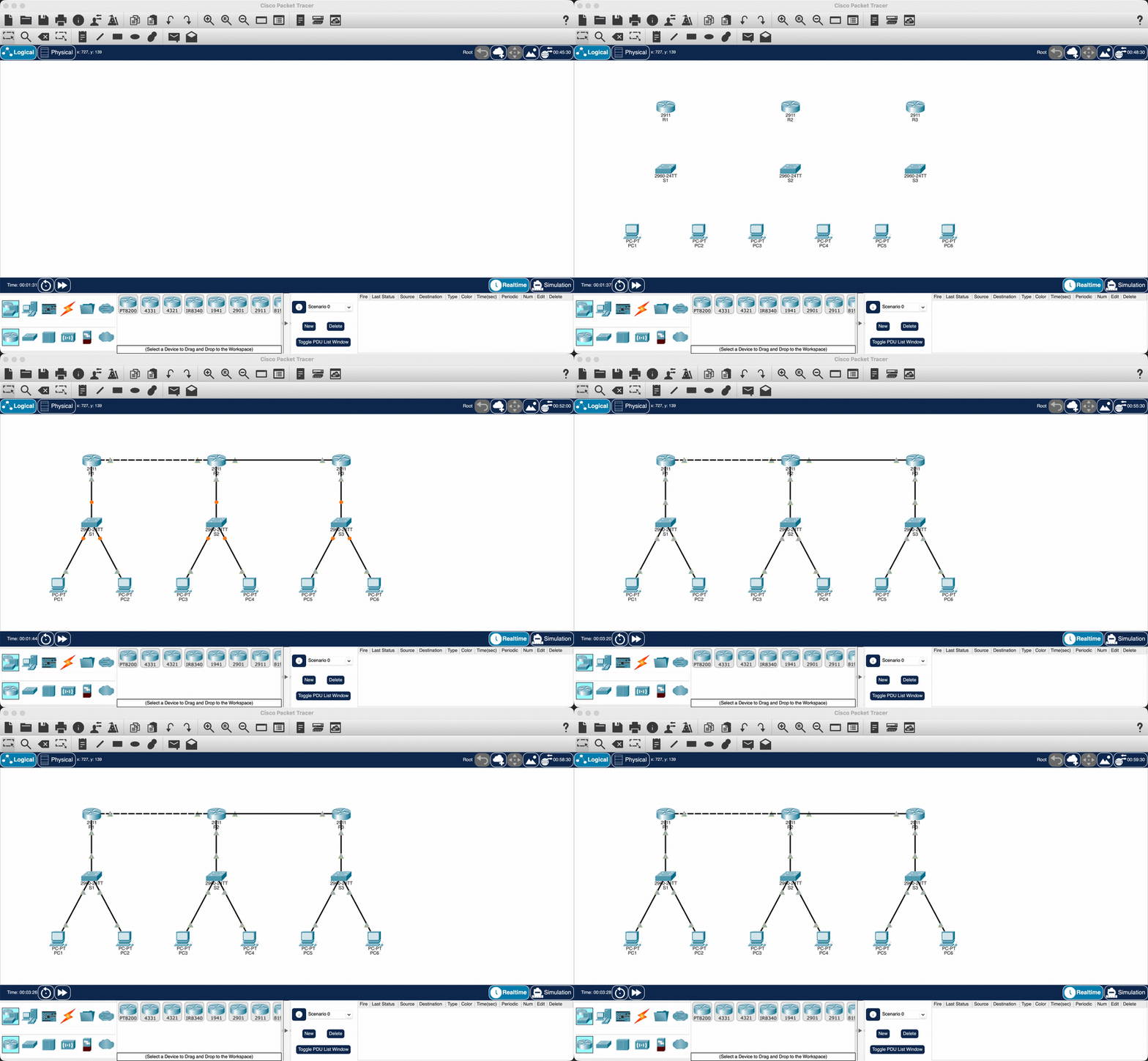
Twelve devices, twelve cables, OSPF across the ring and 6/6 pings, from one prompt.
There are also some ready-made labs (router on a stick, OSPF/EIGRP/RIP topologies, NAT, HSRP, EtherChannel, IPv6) that build in one call.
Install
Needs uv and Packet Tracer 9.
Register the server with your MCP client:
claude mcp add packet-tracer -- uvx --from tracerlab packet-tracer-mcp
Cursor (~/.cursor/mcp.json), VS Code (.vscode/mcp.json) and Codex take the same command:
{
  "mcpServers": {
    "packet-tracer": { "command": "uvx", "args": ["--from", "tracerlab", "packet-tracer-mcp"] }
  }
}
Then install the Packet Tracer side once:
uvx tracerlab install-extension
Restart Packet Tracer and answer Yes when it asks about the new script module. A small "PT-MCP Bridge" window shows up and goes green once the MCP server is running.
If something isn't connecting, run uvx tracerlab doctor.
Use
Open Packet Tracer, start Claude Code and ask for things like:
- build a 3 router OSPF ring with a PC on each LAN and ping everything
- set up router on a stick with VLANs 10, 20, 30 and DHCP
- what's wrong with this network
- show me the running config on R1
examples/enterprise-two-site.pkt is a bigger network built entirely through the tools.
Tests
uv run pytest
mcp-name: io.github.atharv-santosh/tracerlab
Comments
New to MCP?
From what the protocol is to installing your first server, these answers cover most first questions.
An open protocol that defines how AI applications connect to external tools and data in a uniform way. Clients talk to the model; MCP servers provide tools, resources and prompt templates. They exchange standard messages, so one server can be reused by many clients.