
About mcp-event-presence-index
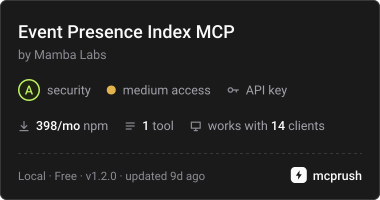
An MCP server that wraps the Mamba Labs Event Presence Index actor on Apify. It helps research teams find conferences and trade shows a company publicly says it attends, with event years where available and the company’s own event reported separately.
Key features
- 01Finds publicly reported event attendance
- 02Returns event years when resolved
- 03Separates a company’s own event
- 04Supports domain and company-name matching
- 05Reports coverage and search failures
Use cases
- 01Research a company’s conference activity
- 02Identify events mentioned for selected years
- 03Distinguish attendance from company-run events
MCP support
Exposes the Apify actor through the `map_company_event_presence` tool for MCP clients. It passes the query through and returns the actor’s output.
Configuration
Local server config is the same for every client. Copy it into your client’s MCP config file.
npx -y @mambalabsdev/mcp-event-presence-indexAPIFY_TOKENSecretApify API token from https://console.apify.com/account/integrationsLocal servers need a runtime on your machine (e.g. Node.js 18+). Config file locations differ by client; see your client’s docs.
Tools
1Saved tool list · updated 2w ago
| Parameter | Type | Required | Description |
|---|---|---|---|
| years | string | No | Comma separated, for example 2025,2026. Events dated outside this set are still returned and flagged. Sent as a string so it works from Clay. Default: "2025,2026". |
| domain | string | Yes | A single company domain, for example 6sense.com. Protocol and path are stripped. |
| skipCache | enum | No | false uses the 21 day result cache. true forces a fresh look. Default: "false".false | true |
| max_queries | enum | No | Between 1 and 5. Each query costs roughly 0.8 seconds plus a 1.3 second pause. 2 is the measured sweet spot: search engines refuse a third query from the same container almost every time, and the third query added no events the first two did not already find. Sent as a string so it works from Clay. Default: "2".1 | 2 | 3 | 4 | 5 |
| company_name | string | No | Improves matching when the brand differs from the domain stem, for example Gong for gong.io. Derived from the domain when left empty. |
| include_own_events | boolean | No | Reports whether the company runs its own conference as a separate field. It is never mixed into the attendance list. Default: true. |
Details
From the project READMEEvent Presence Index MCP Server





MCP server for the Mamba Labs Event Presence Index actor on Apify.
Give it a company domain. It returns the third party conferences and trade shows that company publicly says it attends, with a year for each where one can be resolved, as one flat row. Its own conference is reported separately and never mixed into the attendance list.
Install
npx -y @mambalabsdev/mcp-event-presence-index
Claude Desktop
{
  "mcpServers": {
    "mamba-event-presence-index": {
      "command": "npx",
      "args": ["-y", "@mambalabsdev/mcp-event-presence-index"],
      "env": { "APIFY_TOKEN": "your-apify-token" }
    }
  }
}
Get an Apify token at console.apify.com/account/integrations.
Tool
map_company_event_presence
Company domain in, the events that company says it attends out.
| Input | Type | Required | Notes |
|---|---|---|---|
domain | string | yes | A single company domain, for example 6sense.com. Protocol and path are stripped. |
company_name | string | no | Improves matching when the brand differs from the domain stem, for example Gong for gong.io. Derived from the domain when left empty. |
years | string | no | Comma separated, for example 2025,2026. Events dated outside this set are still returned and flagged. Sent as a string so it works from Clay. Default 2025,2026. |
include_own_events | boolean | no | Reports whether the company runs its own conference as a separate field. It is never mixed into the attendance list. Default true. |
max_queries | enum | no | 1 to 5. 2 is the measured sweet spot: search engines refuse a third query from the same container almost every time. Sent as a string so it works from Clay. Default 2. |
skipCache | enum | no | false uses the 21 day result cache, true forces a fresh look. Default false. |
max_charge_usd | number | no | Optional cost cap in USD for this run. The actor stops before an item that could take its charges past this amount. Omit to rely on the maximum cost per run set in Apify. |
Reading the output
It finds events for roughly 2 companies in 10, and every event it returns is real. An empty row is an honest empty row rather than a guess, so read coverage, fetch_status and queries_failed to tell a company that publishes nothing apart from a search that could not see.
Events dated outside the years you asked for are still returned and flagged, so filter on the event year rather than assuming the input filtered for you.
Billing
You are charged per company analyzed, plus a small actor start fee. A repeat run inside the 21 day cache window costs nothing new.
Price per event on the Apify FREE plan, from the live pricing record; paid Apify plans pay less per event.
| Event | Price (USD) |
|---|---|
Company analyzed (company-analyzed) | 0.005 |
Actor Start (apify-actor-start) | 0.00005 |
Pricing is on the actor's Apify page. Running this server consumes Apify credits.
What this server does and does not do
It is a thin client for the Apify actor. It passes your input through and returns the actor's output unchanged. Every behavior described above lives in the actor, not here.
This is not an events database. It is not a ticketing feed, not a directory of conferences, and not a list of everyone exhibiting at a show. It takes a company and reports what that company publishes about the events it attends.
Errors are surfaced, never swallowed. An invalid input, an invalid token, an exhausted balance, a timeout, or a run that returns anything other than a dataset all come back as an explicit tool error rather than as an empty result.
Source
The actor is on the Apify Store. This wrapper is MIT licensed.
Built by Mamba Labs
Comments
New to MCP?
From what the protocol is to installing your first server, these answers cover most first questions.
An open protocol that defines how AI applications connect to external tools and data in a uniform way. Clients talk to the model; MCP servers provide tools, resources and prompt templates. They exchange standard messages, so one server can be reused by many clients.