
mcp-funding-investor-record
LocalAbout mcp-funding-investor-record
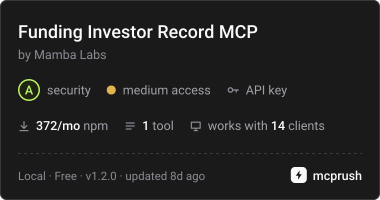
An MCP server for teams that need a company funding record with legal filings and press coverage kept distinct. It checks SEC Form D, Companies House, and press sources, labeling each amount by its source and applying an entity-match gate.
Key features
- 01Reads SEC Form D filings
- 02Checks Companies House registration details
- 03Labels press coverage separately from filings
- 04Rejects near entity matches
- 05Returns one flat JSON row per company
Use cases
- 01Verify funding amounts against regulatory filings
- 02Review UK company registration details
- 03Keep reported funding separate from filed amounts
MCP support
Exposes the `get_company_funding_record` tool to MCP clients. It calls the Apify actor and returns its flat JSON result.
Configuration
Local server config is the same for every client. Copy it into your client’s MCP config file.
npx -y @mambalabsdev/mcp-funding-investor-recordAPIFY_TOKENSecretApify API token from https://console.apify.com/account/integrationsLocal servers need a runtime on your machine (e.g. Node.js 18+). Config file locations differ by client; see your client’s docs.
Tools
1Saved tool list · updated 2w ago
| Parameter | Type | Required | Description |
|---|---|---|---|
| sources | enum | No | Which sources to query. Regulatory sources are filings and are authoritative; press is the most recent and least verified. Choose "regulatory" when a number has to be defensible and "all" when recency matters more.all | regulatory | sec_only | uk_only | press_only |
| skipCache | boolean | No | When false (default) a successful lookup is cached for seven days and reused, which costs you nothing on a repeated run. Set true to force a fresh fetch. |
| company_name | string | No | Strongly recommended here. Every source in this actor is searched by NAME, not by domain, and the name is what the entity gate compares a filing against. A wrong or missing name is the single largest source of wrong rows. |
| minAmountUsd | enum | No | Sets amount_meets_threshold on the row so you can filter to material raises without writing the comparison yourself. It never drops a row and never changes the amount returned.1000000 | 5000000 | 10000000 | 50000000 | none |
| company_domain | string | No | Bare company domain, for example notion.com. Used to derive a company name when none is given, and carried on the row as the join key. |
| lookbackMonths | enum | No | How far back to consider a filing. 36 months by default. A Form D from six years ago is a real filing and usually not a current signal, and this is where you say which you mean.12 | 24 | 36 | 60 | 120 |
| companiesHouseApiKey | string | No | YOUR OWN Companies House REST API key, free at developer.company-information.service.gov.uk. OPTIONAL: without one the UK columns report skipped rather than guessing, and the SEC and press sources still run. A key passed here travels in the tool call and stays in the chat transcript, so prefer setting COMPANIES_HOUSE_API_KEY in this server's environment: when this argument is omitted the server sends that variable instead. |
Details
From the project READMEFunding Investor Record MCP Server





An MCP server that returns a company funding record from SEC Form D, Companies House and press, each labeled with the source it came from. It wraps the Mamba Labs Funding Record from SEC and Companies House actor on Apify and returns a Clay-ready flat JSON row to any MCP client.
What's Inside
- What it does
- Quick start
- Prerequisites
- Example prompts
- Inputs
- Output
- Example output
- Features
- Full actor documentation
- Mamba Labs GTM Suite
- License
What it does
Give it a company name and domain and it reads primary sources and returns a funding record: SEC EDGAR Form D amounts, UK Companies House registration details, and press coverage of funding rounds. One flat row per company.
Every number travels with a source_of_record saying whether it came from a legal filing or from a press release, because those are not the same kind of fact and merging them is the defect this tool exists to prevent. Only an exact entity match, after corporate suffixes are stripped, populates an amount. A near match such as a differently named subsidiary goes to separate related_entity columns as a named lead and can never be summed into a total. This is not Crunchbase and not a resold database, so it returns less than a database would and what it returns has a filing behind it.
All of the lookup runs on Apify. This package is a thin client that calls the actor and hands back the result unchanged.
Quick start
You need Node.js 18 or newer and an Apify account with an API token.
Add this to your Claude Desktop config:
{
  "mcpServers": {
    "mamba-funding-investor-record": {
      "command": "npx",
      "args": ["-y", "@mambalabsdev/mcp-funding-investor-record"],
      "env": {
        "APIFY_TOKEN": "your-apify-token"
      }
    }
  }
}
Get your token at https://console.apify.com/account/integrations, paste it in, and restart Claude Desktop. The get_company_funding_record tool will be available.
Prerequisites
- Node.js 18 or newer
- An Apify account with an API token
- Optional: your own Companies House REST API key, free at developer.company-information.service.gov.uk, if you want the UK columns populated
Example prompts
- "Get the funding record for Anthropic at anthropic.com."
- "Has Notion filed a Form D in the last 24 months? Regulatory sources only."
- "Look up funding for this UK company and flag anything above 10 million dollars."
- "Show me press reported funding for figma.com and keep it separate from any filing."
Inputs
company_domain(optional): bare company domain, for examplenotion.com. Used to derive a company name when none is given, and carried on the row as the join key.company_name(optional but strongly recommended): every source here is searched by name rather than by domain, and the name is what the entity gate compares a filing against. A wrong or missing name is the largest source of wrong rows.sources(optional): which sources to query. One ofall,regulatory,sec_only,uk_onlyorpress_only. Regulatory sources are filings and are authoritative; press is the most recent and least verified. Chooseregulatorywhen a number has to be defensible andallwhen recency matters more.lookbackMonths(optional): how far back to consider a filing. One of12,24,36,60or120, with 36 months the default. A Form D from six years ago is a real filing and usually not a current signal, and this is where you say which you mean.minAmountUsd(optional): one ofnone,1000000,5000000,10000000or50000000. It setsamount_meets_thresholdon the row so you can filter to material raises without writing the comparison yourself. It never drops a row and never changes the amount returned.companiesHouseApiKey(optional): your own Companies House REST API key, free at developer.company-information.service.gov.uk. Without one the UK columns reportskippedrather than guessing, and the SEC and press sources still run.skipCache(optional): when false (the default) a successful lookup is cached for seven days and reused. Set true to force a fresh fetch.max_charge_usd(optional): a cost cap in USD for this run. The actor stops before an item that could take its charges past this amount. Omit it to rely on the maximum cost per run set in Apify.
Output
The tool returns the actor's flat JSON row for the company, with 32 snake_case fields and no nested objects. source_of_record says where a number came from, form_d_entity_match and uk_entity_match record how strict the entity match was, and filings_rejected counts what the entity gate turned away. See the Apify Store page for the full output schema.
Example output
{
  "degraded": false,
  "degradation_reason": null,
  "company_domain": "anthropic.com",
  "company_name": "Anthropic",
  "source_of_record": "multiple",
  "form_d_filed": true,
  "form_d_date": "2026-06-01",
  "form_d_entity_name": "WU Anthropic LP",
  "form_d_entity_match": "exact",
  "form_d_accession": "0002109576-26-000001",
  "filings_rejected": 56,
  "uk_company_number": "14604577",
  "uk_company_name": "ANTHROPIC LIMITED",
  "uk_company_status": "active",
  "uk_entity_match": "exact",
  "uk_incorporation_date": "2023-01-19",
  "press_amount": 65000000000,
  "press_currency": "$",
  "press_url": "https://techcrunch.com/2026/05/28/anthropic-raises-65-billion-nears-1t-valuation-ahead-of-ipo/",
  "related_entity_name": null,
  "amount_meets_threshold": null,
  "sources_queried": "sec_form_d, companies_house, press",
  "coverage": 0.9,
  "fetch_status": "ok",
  "run_date": "2026-08-23T09:56:16.906Z"
}
Features
- SEC Form D filings, returned with the accession number
- UK Companies House registration details, with your own key
- Press coverage labeled as press and never merged with a filing
- Primary sources only, not a resold database
- Entity identity gate, so a near name match is rejected and recorded
- Rejection accounting in
filings_rejectedandrelated_entity_note - 32 flat snake_case fields, one row per company
Pricing
Price per event on the Apify FREE plan, from the live pricing record; paid Apify plans pay less per event.
| Event | Price (USD) |
|---|---|
Actor Start (apify-actor-start) | 0.00005 |
Company checked (company-checked) | 0.0045 |
Filing found (filing-found) | 0.006 |
Press signal found (press-signal-found) | 0.004 |
Full actor documentation
This server is a thin client and holds no lookup logic. For the complete input and output reference, pricing, and run history, see the Apify Store page:
https://apify.com/mambalabs/funding-investor-record
Mamba Labs GTM Suite
This server is one of the Mamba Labs GTM Suite MCP servers. Every actor in the suite takes a domain or a company and returns one flat row, so they stack in the same Clay table without reshaping anything. The actor behind this server is the Funding Record from SEC and Companies House, immutable Apify actor ID OFS4Mt1gyYNtGfUbE.
Built by Mamba Labs | npm | Apify Store
License
MIT
Built by Mamba Labs. https://apify.com/mambalabs
Comments
New to MCP?
From what the protocol is to installing your first server, these answers cover most first questions.
An open protocol that defines how AI applications connect to external tools and data in a uniform way. Clients talk to the model; MCP servers provide tools, resources and prompt templates. They exchange standard messages, so one server can be reused by many clients.