
About mcp-page-finder-extractor
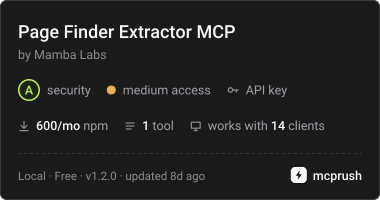
mcp-page-finder-extractor finds specified page types on a company's public website from its domain or company identity. It supports 46 page types across 11 European-language discovery vocabularies, with optional structured extraction.
Key features
- 01Finds 46 types of company pages
- 02Accepts domains or company identities
- 03Supports 11 European discovery languages
- 04Optionally extracts structured page fields
- 05Returns URL, discovery method, and confidence
Use cases
- 01Locate pricing pages across a list of companies
- 02Find security or compliance pages for review
- 03Extract structured fields from public company pages
MCP support
This MCP server exposes the `find_company_page` tool to locate pages and optionally extract fields. It returns results as datasets and reads publicly available pages on company-owned websites.
Configuration
Local server config is the same for every client. Copy it into your client’s MCP config file.
npx -y @mambalabsdev/mcp-page-finder-extractorAPIFY_TOKENSecretApify API token from https://console.apify.com/account/integrationsLocal servers need a runtime on your machine (e.g. Node.js 18+). Config file locations differ by client; see your client’s docs.
Tools
1Saved tool list · updated 2w ago
| Parameter | Type | Required | Description |
|---|---|---|---|
| mode | enum | No | locate returns the page URL, the method and a confidence. locate_and_extract also reads the page and returns structured fields into a second findings dataset. Default: "locate".locate | locate_and_extract |
| domain | string | No | A single company domain, for example stripe.com. Protocol and path are stripped. Supply this or domains or companies. |
| domains | array | No | Several company domains. Every one returns a row, including the ones where nothing is found. |
| companies | array | No | Companies you have a name for but not a domain. Identity resolution runs first on this path and is charged as its own event. Use domains instead whenever you hold a domain. |
| knownUrls | object | No | URLs you already hold, keyed by page type, for example {"pricing": "https://stripe.com/pricing"}. Discovery is skipped for that page type, which is faster and exact. |
| pageTypes | array | No | Which page types to locate. Each one costs a locate event and adds requests, so ask for what you will use. Default: ["pricing"]. |
| skipCache | enum | No | false uses the 14 day cache. true forces a fresh crawl. Default: "false".false | true |
| allowRender | enum | No | true opens a browser for pages that serve no readable HTML, which is most Nordic investor calendars. A browser is never used against a block, a CAPTCHA, a login or robots.txt. Default: "true".true | false |
| concurrency | any | No | How many companies to work on at once. Per company the actor is still strictly one request at a time with a delay, so this does not make it impolite to any single site. A number or a numeric string. Default: 10. |
| languageHints | array | No | Language codes to try first, for example ["de","fr"]. Vocabulary is multilingual by default in all 11 languages; this only reorders it and never shortens it. |
| maxPagesPerType | any | No | Between 1 and 12. Candidate pages opened per page type before giving up. Lowering it is faster and finds less. A number or a numeric string. Default: 4. |
| extractionFields | array | No | The page agnostic extraction menu, available on any page type. Only used in locate_and_extract mode. Omit for all of them. |
| maxRequestsPerInput | any | No | Between 5 and 200. Hard ceiling on requests to one company's site. Hitting it returns coverage partial rather than a false negative. A number or a numeric string. Default: 60. |
| extractPageTypeFields | enum | No | true also runs the field map bound to the page type: pricing plans, filing rows and a derived fiscal year end, certifications, ATS host, governing law. Only used in locate_and_extract mode. Default: "true".true | false |
Details
From the project READMEPage Finder and Extractor MCP Server





Give it a company domain and name a page type. It finds that page on the company's own website and returns the URL, the method that found it, and a confidence for that method.
46 page types. Discovery vocabulary in 11 European languages. Optionally reads the page and returns structured fields.
Wraps the Page Finder and Extractor actor by Mamba Labs.
Install
npx -y @mambalabsdev/mcp-page-finder-extractor
Requires an Apify API token in APIFY_TOKEN. Create one at console.apify.com/account/integrations.
Claude Desktop
{
  "mcpServers": {
    "mamba-page-finder-extractor": {
      "command": "npx",
      "args": ["-y", "@mambalabsdev/mcp-page-finder-extractor"],
      "env": {
        "APIFY_TOKEN": "your-apify-token"
      }
    }
  }
}
Tool
find_company_page
| Input | Required | What it does |
|---|---|---|
domain | one of these three | A single company domain, for example stripe.com |
domains | one of these three | Several company domains |
companies | one of these three | Companies by name, as {name, country?, isin?, ticker?, url?}. Identity resolution runs first and is charged separately |
pageTypes | no | Which of the 46 page types to find. Default ["pricing"] |
mode | no | locate for URLs, locate_and_extract to also read the page. Default locate |
knownUrls | no | URLs you already hold, keyed by page type. Skips discovery for those |
extractionFields | no | The page agnostic extraction menu |
extractPageTypeFields | no | Also run the field map bound to the page type. Default "true" |
maxPagesPerType | no | 1 to 12, candidate pages opened per type. A number or a numeric string. Default 4 |
maxRequestsPerInput | no | 5 to 200, ceiling on requests per company. A number or a numeric string. Default 60 |
allowRender | no | Open a browser for pages that need JavaScript. Default "true" |
languageHints | no | Language codes to try first. Reorders vocabulary, never shortens it |
max_charge_usd | no | Spend cap for the run, in USD. The run starts no company whose worst case cost would cross it and writes one notice row. Empty means no cap of your own |
concurrency | no | How many companies to work on at once. Per company the actor still makes one request at a time with a delay. A number or a numeric string. Default 10 |
skipCache | no | "true" forces a fresh crawl instead of the 14 day cache |
The 46 page types: pricing, demo_request, free_trial, procurement_vendor, about, leadership_team, locations, investor_relations, annual_report, governance, security_trust_center, compliance_certifications, privacy_policy, terms_of_service, dpa_subprocessors, accessibility_statement, status_page, careers, job_board, benefits, culture, documentation, api_reference, integrations, changelog, roadmap, developer_portal, blog, press_newsroom, case_studies, customers_logos, resources_library, events_webinars, podcast, media_kit, partners, reseller_channel, affiliate_program, marketplace_listing, community, contact, support_help_center, login_app, sustainability_esg, diversity_programs, giving_volunteering.
Reading the output
One flat row per input, always, including the ones where nothing was found.
{type}_urlis the located page, for examplepricing_url.{type}_foundistrue,falseornull. These are never collapsed.falsemeans the site was read, its link graph and sitemap were searched, and the page is not there.nullmeans not enough was readable to say so.{type}_methodis how it was found:known_url,known_host,homepage_anchor,footer_anchor,section_hop,sitemaporpath_guess. Precision differs sharply between them.{type}_confidenceis scored for that method, not blended. Threshold at 0.8 for anything a customer will see. Apath_guessnever scores above 0.6.coverageandfetch_statussay whether the look completed. Read them before trusting afalse.
In locate_and_extract mode the structured fields land in a second findings dataset, one record per field, keyed back by input_key, because eleven filing rows do not fit in one cell.
Billing
Pay per event on Apify credits. Roughly, at the FREE tier: $0.004 per page type located, $0.003 per page extracted, $0.007 per company name resolved, and the standard actor start fee.
Free until 2026-11-10: from 2026-10-26 the three work events are not charged and a run pays only the actor start fee. The prices above take effect again on 2026-11-10 at 05:01 UTC.
A look that happens is billed, including the ones that come back empty, because the work is the same either way. A look that does not happen is not billed: a dead domain, a refusal, or a robots.txt disallow returns found: null and no locate charge.
You are never charged for identity resolution unless you use the companies path.
What this server does and does not do
It reads publicly available pages on the company's own website. It honors robots.txt per host including Crawl-delay, makes one request at a time per domain with a delay, and sends a descriptive user agent that names it. It does not impersonate a browser, does not sign headers, and does not retry to get around a block. Where a page is publicly served but needs JavaScript to read, a browser renders it; a browser is never used against an access control.
Personal data. Two page types can return a named person: contact returns the contact block a company publishes on its own contact page, and about returns leadership names published on its own about page. Only what the company published, no inferred attributes, no lookups elsewhere. Those records carry is_personal_data: true and a lawful_basis, so the whole class filters out with one predicate, or leave contact and about out of pageTypes and none is produced. For a roster of people at a company, use Team Page People Extractor instead.
This server is read only. It starts an actor run and returns the dataset. It writes nothing anywhere else.
Mamba Labs GTM Suite
This server is one of the Mamba Labs MCP servers for go-to-market data, each backed by its own actor on the Apify Store. If you would rather install one package than many, @mambalabsdev/mcp-gtm-suite exposes the suite through a single server.
Browse the whole fleet on the Apify Store or on npm.
If you want a roster of people at a company rather than a page on its website, use Team Page People Extractor and Contact Classifier instead. This actor returns a contact block only when it happens to sit on a page you asked it to find.
Source
The actor is on the Apify Store. This wrapper lives at github.com/mambalabsdev/mcp-page-finder-extractor and is MIT licensed.
Built by Mamba Labs.
Comments
New to MCP?
From what the protocol is to installing your first server, these answers cover most first questions.
An open protocol that defines how AI applications connect to external tools and data in a uniform way. Clients talk to the model; MCP servers provide tools, resources and prompt templates. They exchange standard messages, so one server can be reused by many clients.