
About mcp-tiktok-brand-presence-mapper
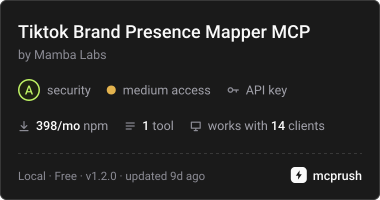
This MCP server uses an Apify Actor to resolve a TikTok handle or company domain to a brand’s official account, returning profile details and engagement counts. It helps verify a brand’s TikTok presence and flags identity mismatches instead of returning counts for an unverified account.
Key features
- 01Find a brand account by handle or company domain
- 02Return follower, following, like, and video counts
- 03Provide verification status, bio, and bio link
- 04Flag accounts that fail identity checks
- 05Support caching and a per-call spending cap
Use cases
- 01Check whether a company has an official TikTok account
- 02Review a brand account’s followers and content counts
- 03Verify that a candidate account matches a company
MCP support
Exposes the `map_tiktok_brand_presence` tool to resolve and check brand TikTok accounts. It calls an Apify Actor and requires APIFY_TOKEN.
Configuration
Local server config is the same for every client. Copy it into your client’s MCP config file.
npx -y @mambalabsdev/mcp-tiktok-brand-presence-mapperAPIFY_TOKENSecretApify API token from https://console.apify.com/account/integrationsLocal servers need a runtime on your machine (e.g. Node.js 18+). Config file locations differ by client; see your client’s docs.
Tools
1Saved tool list · updated 2w ago
| Parameter | Type | Required | Description |
|---|---|---|---|
| handle | string | No | The TikTok handle, with or without the leading @, for example shopify. This is the PRIMARY input: only 4 of 14 B2B homepages declare a TikTok link, so supplying the handle is both cheaper and far more reliable than asking the actor to find it. |
| skipCache | boolean | No | When "false" (default) a successful lookup is cached for seven days and reused. Set "true" to force a fresh fetch. Sent as a string for Clay compatibility. |
| company_name | string | No | Optional. Improves search accuracy and is what the identity gate checks a discovered account against. |
| company_domain | string | No | Bare company domain, for example shopify.com. Used to FIND the handle when you do not have one, and to identity check a handle that discovery guessed. Supplying both is the best case. |
| escalateOnBlock | boolean | No | TikTok answers most requests over cheap datacenter routing and blocks a minority with a bot detection page. When "true" (default) a blocked fetch is retried once over residential, which recovers most of them at a higher cost per recovered row. Set "false" to accept the block and return status blocked. Sent as a string for Clay compatibility. |
| includeFollowerCounts | boolean | No | When "true" (default) the profile page is fetched and the counts are extracted. Set "false" to resolve the profile URL only, which is cheaper and needs no proxy. Sent as a string for Clay compatibility. |
Details
From the project READMETikTok Brand Presence Mapper MCP Server




MCP server for the Mamba Labs TikTok Brand Presence Mapper actor on Apify.
Resolve a TikTok handle or a company domain to the brand account with follower, like and video counts.
What it does
Resolve a TikTok handle, or a company domain, to that brand's official TikTok account. Returns follower, following, like and video counts, verification status, display name, bio and the account's outbound bio link, as one flat Clay ready row. Counts above roughly ten thousand are rounded by TikTok and the row flags that. A guessed account that fails the identity check is reported as identity_mismatch with no counts rather than being returned as the company's. Read only; requires an APIFY_TOKEN and consumes Apify credits per call.
Quick start
Add this to your MCP client configuration:
{
  "mcpServers": {
    "mamba-tiktok-brand-presence-mapper": {
      "command": "npx",
      "args": ["-y", "@mambalabsdev/mcp-tiktok-brand-presence-mapper"],
      "env": { "APIFY_TOKEN": "your-apify-token" }
    }
  }
}
Prerequisites
- Node.js 18 or newer
- An Apify API token from console.apify.com/account/integrations
The actor is pay per event and consumes Apify credits per call. Pricing is on the actor page.
Example prompts
- "How many TikTok followers does Gymshark have?"
- "Find the TikTok account for allbirds.com and tell me if it is verified."
- "Check whether patagonia.com has a TikTok presence at all."
Tool and inputs
Tool: map_tiktok_brand_presence
| Input | Type | Meaning |
|---|---|---|
handle | string | The TikTok handle, with or without the leading @, for example shopify. This is the PRIMARY input: only 4 of 14 B2B homepages declare a TikTok link, so |
company_domain | string | Bare company domain, for example shopify.com. Used to FIND the handle when you do not have one, and to identity check a handle that discovery guessed. |
company_name | string | Optional. Improves search accuracy and is what the identity gate checks a discovered account against. |
includeFollowerCounts | boolean | When "true" (default) the profile page is fetched and the counts are extracted. Set "false" to resolve the profile URL only, which is cheaper and need |
skipCache | boolean | When "false" (default) a successful lookup is cached for seven days and reused. Set "true" to force a fresh fetch. Sent as a string for Clay compatibi |
escalateOnBlock | boolean | TikTok answers most requests over cheap datacenter routing and blocks a minority with a bot detection page. When "true" (default) a blocked fetch is r |
max_charge_usd | number | Optional spending cap for this call, in USD. The actor stops before any charge that would take the run past this amount and keeps every row already charged. |
Reading the output
Every row carries a per platform _status field, and it is the field to read
first. The vocabulary is the same across the whole Mamba Labs social family:
| Status | Meaning |
|---|---|
ok | fetched and parsed, the value is there |
not_found | we looked and there is no such profile |
not_extractable | the profile exists and the value is not on the wire to us |
blocked | the platform refused us, worth retrying later |
identity_mismatch | we found a real profile and it belongs to someone else |
skipped | you did not ask for this platform |
false and null are never interchangeable. false means we looked and the
answer is no. null means we could not look. If you filter for companies with no
presence, filter on false, because null rows are unknown rather than absent.
Pricing
You pay per event on Apify, billed to your own Apify account. Prices from the live pricing record, read 2026-10-16:
| Event | Price per event (USD) | Fires when |
|---|---|---|
apify-actor-start | $0.00005 | Charged when the Actor starts running. Number of events charged depends on Actor memory (one event per GB, minimum one event). |
company-checked | $0.004 on the Free plan, down to $0.0028 on higher Apify plans | Once per company for which the discovery cascade completed and a non degraded row was produced, whether or not a TikTok profile was found. Does not fire on a degraded row, because on a degraded row no discovery was performed. |
profile-resolved | $0.003 on the Free plan, down to $0.0021 on higher Apify plans | Once per company whose candidate TikTok URL passed the identity gate. Fires on the validation work, not on a populated count. A candidate dropped as an impersonator does not charge: the work was done and the honest answer is that there is no such profile. |
follower-count-extracted | $0.0025 on the Free plan, down to $0.00175 on higher Apify plans | Once per company where a numeric follower count was read off the public page. Does not fire on not_extractable, blocked, identity_mismatch or url only runs. |
The actor's Apify page carries the current prices. Running this server consumes Apify credits.
Full actor documentation
apify.com/mambalabs/tiktok-brand-presence-mapper
Mamba Labs GTM Suite
Mamba Labs builds a fleet of GTM enrichment actors that share one flat, Clay
ready output convention, so their rows join on company_domain with no cleaning
step. Full fleet: apify.com/mambalabs
License
MIT
Comments
New to MCP?
From what the protocol is to installing your first server, these answers cover most first questions.
An open protocol that defines how AI applications connect to external tools and data in a uniform way. Clients talk to the model; MCP servers provide tools, resources and prompt templates. They exchange standard messages, so one server can be reused by many clients.