
About Trentina
Trentina is a security gateway between AI agents and their MCP servers, web access, messaging, and LLM providers. It applies layered prompt-injection defenses, policy checks, and per-agent profiles while reducing tool and response context.
Key features
- 01Three-layer prompt-injection checks
- 02Policy-based checks on outgoing calls
- 03Tool filtering and schema compression
- 04Per-agent profiles and credentials
- 05OAuth authorization for web clients
- 06Auditing and defense monitoring
Use cases
- 01Inspect untrusted content entering an agent
- 02Restrict tools and validate their arguments and results
- 03Give different agents separate backends and credentials
- 04Connect web clients through OAuth authorization
MCP support
Provides a gateway endpoint per profile for MCP clients, routing requests to configured backends and applying tool policies and defenses. It can also expose Trentina's own content tools.
Configuration
Local server config is the same for every client. Copy it into your client’s MCP config file.
Tools
13Saved tool list · updated 2w ago
| Parameter | Type | Required | Description |
|---|---|---|---|
| url | string | Yes | URL to fetch (http:// or https://) |
Details
From the project README

Trentina
Trentina sits between your AI agents and everything they touch: MCP servers, the web, Matrix, LLM providers and alerts. It stops prompt injection at every ingress, shrinks what reaches the context window, and enforces a policy the agent cannot talk its way past. It is named after the 1377 trentino of Ragusa, where ships anchored offshore for thirty days before anyone came ashore: commerce keeps flowing, and nothing dangerous gets in.
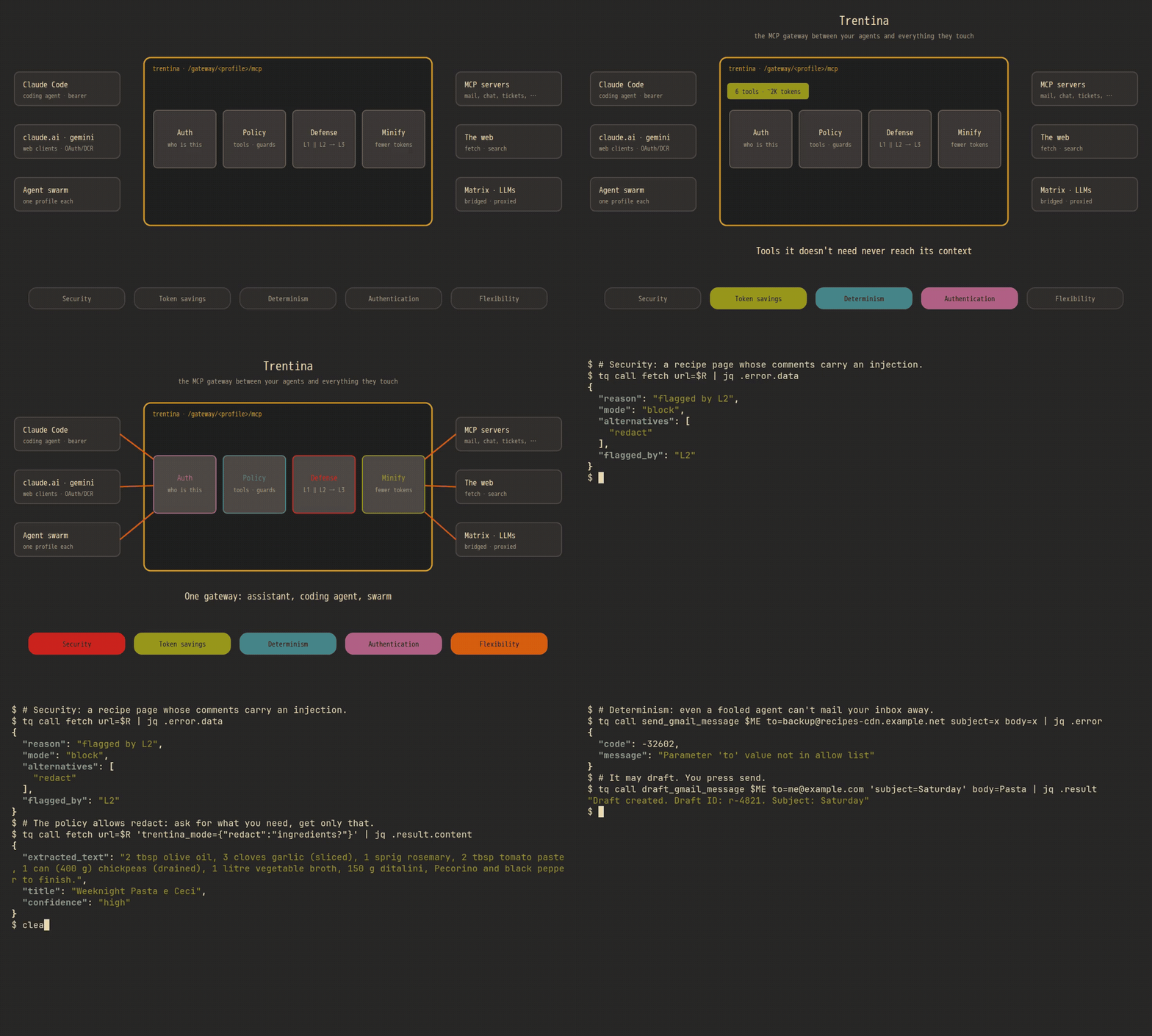
Why Trentina
-
Security. Untrusted content crosses three independent layers at every ingress: L1 deterministic checks, L2 a local classifier, L3 a quarantined LLM with no tools. Guarded execution judges what goes out against a rule you write in English. What is and is not defended is in Coverage. Defense Pipeline · Benchmark · OWASP mapping
-
Token savings. Hidden tools, short names, compacted schemas, compressed descriptions and minified responses: 52% fewer response bytes on production traffic. Compression · Tool Filtering
-
Determinism. Parameter guards, response guards and allowlists are evaluated by the gateway, so an agent that ignores its instructions is stopped before the backend sees the call. Parameter Guards · Response Guards
-
Authentication. Trentina is the OAuth authorization server for web clients such as claude.ai: dynamic client registration, a provisioned client, external issuers or a static bearer, chosen per profile. Authentication
-
Architectural flexibility. A personal assistant, a coding agent and a swarm each get their own profile, with their own backends, defense mode and credentials. Profiles · Operator
Quick Start
# The container image is the distribution: the L2 model, the parsers and
# their process isolation ship in it. There is no PyPI package.
podman run -d -p 127.0.0.1:8019:8019 \
    -v ./profiles.yaml:/config/profiles.yaml:ro,Z \
    -e TRENTINA_GATEWAY_ENABLED=true \
    -e TRENTINA_PROFILES_PATH=/config/profiles.yaml \
    -e TRENTINA_PROFILE_MYAGENT_TOKEN=your-token \
    -e OPENROUTER_API_KEY=your-key -e TRENTINA_MODEL_PROVIDER=openrouter \
    quay.io/crunchtools/trentina \
    --transport streamable-http --host 0.0.0.0 --port 8019
L3 needs a key for one LLM provider. Any of Gemini, OpenRouter, OpenAI,
Anthropic or Ollama works. A minimal profiles.yaml:
profiles:
  myagent:
    auth:
      bearer_token_env: TRENTINA_PROFILE_MYAGENT_TOKEN
    backends:
      web:
        url: "internal://web"         # Trentina's own content tools
        tools_allow: ["*"]
      gmail:
        url: "http://gws-personal:8000/mcp"
        tools_allow:                  # it may read and draft; you send
          - search_gmail_messages
          - get_gmail_message_content
          - draft_gmail_message
    defense:
      enforcement: block
Then point Claude Code at it:
{
  "mcpServers": {
    "trentina": {
      "type": "streamable-http",
      "url": "http://localhost:8019/gateway/myagent/mcp",
      "headers": { "Authorization": "Bearer your-token" }
    }
  }
}
Documentation
| Document | Description |
|---|---|
| MCP Gateway | One endpoint per profile: routing, tool names, circuit breakers |
| Per-Agent Profiles | Profile schema, modes, minifying, roles, multi-agent setup |
| Operator Profile | The agent that installs and runs the gateway |
| Configuration | Every environment variable |
| Authentication | Static bearer, OAuth proxy with DCR or a provisioned client, delegated issuers |
| Backend OAuth | Each profile signs in to OAuth-only backends with its own grant |
| Defense Pipeline | L1/L2/L3, modes, coverage and known gaps |
| Benchmark | Detection rates per layer and per L3 provider |
| Corpora | Every attack and benign set the defense is measured on |
| Prompt Packs | The judge's prompts tuned per model |
| Content Tools | fetch, read, dir, content, search, with an egress guard and file confinement |
| Blocklist | A refused source stays refused |
| Tool Filtering | Allowlists, denylists, glob patterns |
| Tool Pinning | A new or changed tool is held until approved |
| Tool Discovery | Find/call or per-session loading for clients without tool search |
| Description Compression | Description compression and schema compaction |
| Token Routing | Response minifying (implemented); delegation (proposed) |
| Guarded Execution | A judge reads calls to listed tools against a policy in plain English |
| Parameter Guards | Per-tool argument validation |
| Response Guards | Per-tool result validation |
| Audit Log | Call recording, stats, monitoring |
| LLM Key Proxying | Provider keys kept inside the gateway |
| Matrix Bridge | E2EE termination and two-way judging |
| Channel Bridges | More than one upstream per agent (RCS, ...) and the bridge wire contract |
| Matrix Reverse Proxy | Matrix for agents on an isolated network |
| Client Egress | A CONNECT tunnel to listed hosts for the agent's own client |
| Git Transport | Clone, fetch and push to listed repositories and branches |
| HTTP(S) Egress | An agent's outbound request judged and re-originated to a named destination |
| Deployment Hardening | Container flags, secrets, egress, the startup check |
| Cockpit Plugin | Live defense pipeline dashboard |
| Internal: Gateway Design | Original design document, for contributors |
Development
uv sync --all-extras
uv run ruff check src tests
uv run mypy src
uv run pytest -v
The container image is built by CI, never locally; see CLAUDE.md. The demo
is recorded by demo.yml; its fixtures are in
docs/demo/.
License
AGPL-3.0-or-later
Comments
New to MCP?
From what the protocol is to installing your first server, these answers cover most first questions.
An open protocol that defines how AI applications connect to external tools and data in a uniform way. Clients talk to the model; MCP servers provide tools, resources and prompt templates. They exchange standard messages, so one server can be reused by many clients.