
code-graph
LocalAbout code-graph
code-graph is a local dependency-graph tool for developers and AI agents, available through a CLI and MCP server. Its deterministic analysis traces routes, calls, tables, and configuration with file-and-line evidence, without using an LLM to build the graph.
Key features
- 01Trace callers, routes, and table dependencies
- 02Show file-and-line evidence for graph edges
- 03Analyze change impact and relevant tests
- 04Link client calls to server routes across repos
- 05Report attack surfaces and security findings
- 06Provide a visual graph and plan checks
Use cases
- 01Find affected routes and callers before a change
- 02Identify tests reached by a code change
- 03Check for unguarded routes that write data
- 04Review cross-repository HTTP calls and server routes
MCP support
code-graph provides the cg-mcp MCP server, allowing agents to query dependency graphs instead of grepping code; one server can serve multiple graphs.
Configuration
Local server config is the same for every client. Copy it into your client’s MCP config file.
Tools
13Saved tool list · updated 1w ago
| Parameter | Type | Required | Description |
|---|---|---|---|
| paths | boolean | No | |
| targets | array | Yes | |
| group_by | string | No | |
| platform | any | No | |
| connection | any | No | |
| include_gated | boolean | No | |
| max_per_group | integer | No | |
| min_confidence | string | No |
Details
From the project READMEcode-graph
See everything a change affects before you make it: a local, deterministic dependency graph of routes, calls, tables and config, with file:line evidence for every hop.
For you and your AI agent (CLI + MCP). No LLM in the graph.





Docs · Quick start · CLI · MCP · Changelog
Quick start
pipx install cg-code-graph          # or: uv tool install cg-code-graph
cg index . --db out/graph.db        # prints starter queries for your repo
cg install --host cursor    # or claude, codex, vscode, …: registers the MCP server and a "use cg first" agent rule
cg reaches table:orders --db out/graph.db   # any table, connection or config key
Try it on a bundled sample, link a frontend to a backend, or connect an agent over MCP: Quick start guide. Other install options (install.sh, Windows, exact-mode toolchains): Install.
cg reaches table:store_books on the bundled Django sample:
dependents: 18 nodes  (code: 6, entry points: 9, other: 3)
== RUNTIME (reached from http_route / ... / queue_job / listener): 5 functions/methods
    catalog.api.create_book  depth=1 conf=resolved  http_route(1)
        path: function:catalog.api.create_book
          -WRITES_TABLE[resolved @ catalog/api.py:27]-> table:store_books
    catalog.signals.review_saved  depth=3 conf=resolved  listener(1)
        path: function:catalog.signals.review_saved
          -DISPATCHES[exact @ catalog/signals.py:12]-> job:catalog.tasks.recompute_rating
          -HANDLED_BY[exact @ catalog/tasks.py:13]-> function:catalog.tasks.recompute_rating
          -READS_TABLE[resolved @ catalog/tasks.py:14]-> table:store_books

Supported languages
| Language | Frameworks and facts | Calls | Docs |
|---|---|---|---|
 | Django (+ DRF, django-ninja), FastAPI / Starlette, Flask, Celery | exact (stdlib ast) | Python |
  | Nuxt / Vue, NestJS, Next.js, Astro, Express, Fastify, Koa, Hono, Elysia, React Router / Remix | exact (TypeScript compiler API) | TS frameworks |
 | Laravel (routes, route attributes, middleware, queues, broadcasting, outbound HTTP) | exact (nikic/php-parser; needs PHP 8.2+) | PHP |
 | Flutter | exact (Dart analyzer; needs the Dart SDK) | Platforms |
 | Android, Kotlin Multiplatform, Spring | heuristic; exact with scip-java (opt-in) | Kotlin |
 | Spring (routes, guards, beans, tables, clients) | heuristic; exact with scip-java (opt-in) | Java |
 | iOS / SwiftPM | heuristic; exact with the Swift index store (opt-in) | Swift |
   | crates / modules, entry points, FFI, #[cfg] / #if gates | heuristic; exact with rust-analyzer / scip-clang | Rust, C and C++ |
Go and others: import a SCIP index with cg index --scip FILE. Run cg doctor to see exact / heuristic per language on your machine.
What you get
reaches,impact,path: every caller, route, job and page that reaches a table, config key or method.cg affected --base main: the tests and entry points a change reaches (--quietfeeds your test runner).- Across repos:
cg linkmatches client HTTP calls (frontends and Laravel / Guzzle backends) to server routes, and checks request keys (Laravel FormRequest, Elysia schemas, Nuxt / TypeScript bodies). - Route guards:
cg routes --writes --unguardedlists routes that write with no auth guard. Laravel checks inside the action count as inline guards unless--strict. - Security views:
cg surfacelists the inbound / outbound attack surface and findings (hardcoded credentials, plaintext protocols, unverified webhooks, unguarded handlers, listeners on all interfaces, disabled TLS / SSH verification, plaintext gRPC, exposed IPC, outbound URLs built from request input) as text, JSON or SARIF, with--fail-onfor CI. - MCP server (
cg-mcp) so agents query the graph instead of grepping. One server can serve many graphs (graphsplus an optionalgraphargument); a single--dbstays one graph. See MCP. - Visual view (
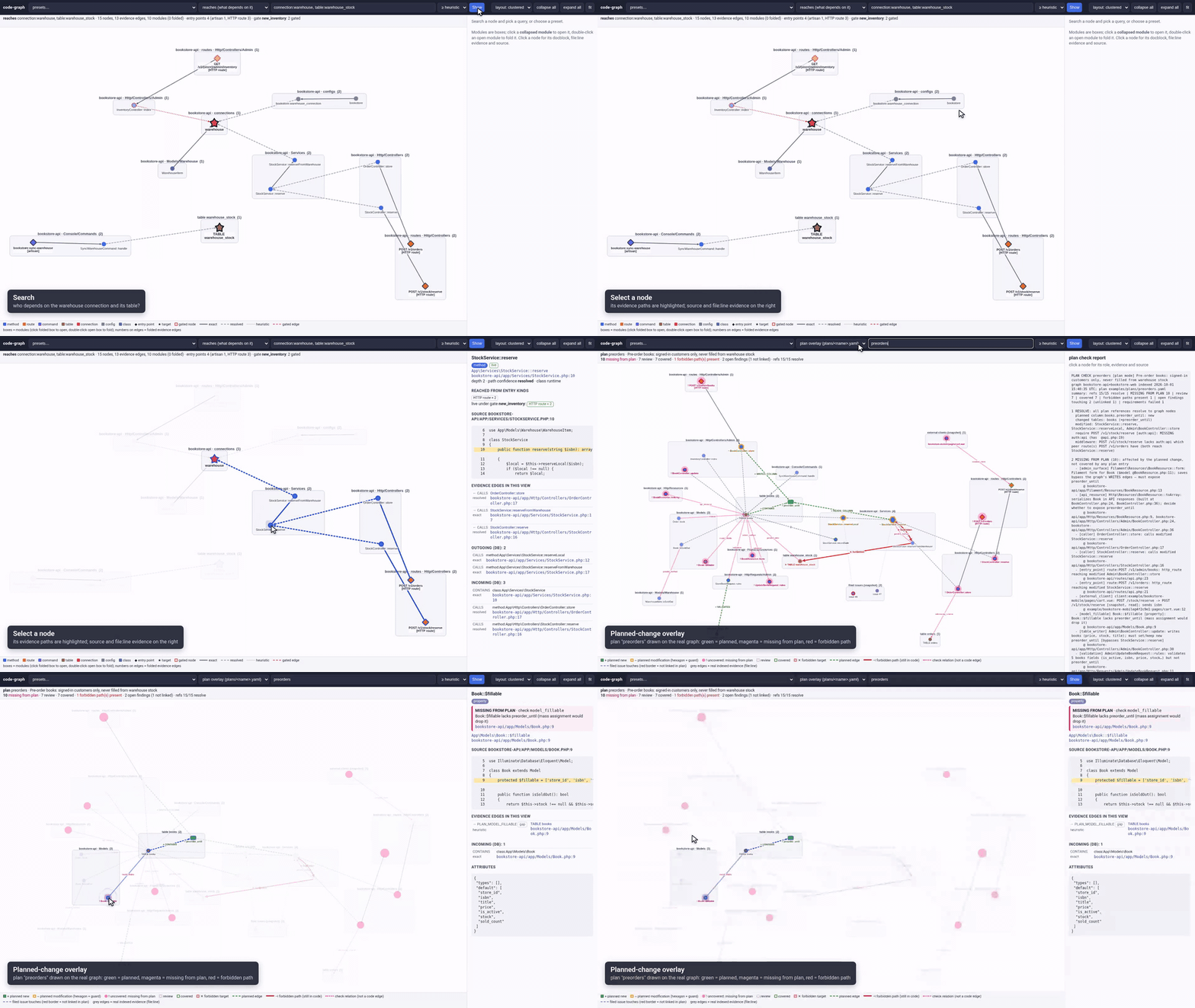
cg serve) and plan checks (cg plan check) for planned changes.
Docs
Install · Quick start · CLI · MCP · Configuration · Architecture · Limitations
Changelog · Contributing · Security · MIT License
More recordings: docs/media.
Comments
New to MCP?
From what the protocol is to installing your first server, these answers cover most first questions.
An open protocol that defines how AI applications connect to external tools and data in a uniform way. Clients talk to the model; MCP servers provide tools, resources and prompt templates. They exchange standard messages, so one server can be reused by many clients.