
About SolidPing
SolidPing is a self-hostable uptime monitoring system for teams that need checks, incident handling, and status pages. It runs as a single Go binary and supports distributed workers, private agents, and a wide range of service checks.
Key features
- 0144 types of uptime checks
- 02Distributed workers and private agents
- 03Incident and on-call escalation management
- 04Status pages
- 05Single Go binary deployment
Use cases
- 01Monitor website and API availability
- 02Check databases, messaging, and network services
- 03Track incidents and on-call escalations
- 04Publish service status pages
Configuration
Remote servers need no local install. Pick your client, then copy the config or install in one click.
https://solidping.io/api/v1/mcpclaude mcp add --transport http fclairamb-solidping https://solidping.io/api/v1/mcp{"mcpServers":{"fclairamb-solidping":{"type":"http","url":"https://solidping.io/api/v1/mcp"}}}Open in Cursor{"servers":{"fclairamb-solidping":{"type":"http","url":"https://solidping.io/api/v1/mcp"}}}Open in VS Code{"mcpServers":{"fclairamb-solidping":{"type":"http","url":"https://solidping.io/api/v1/mcp"}}}{"mcpServers":{"fclairamb-solidping":{"serverUrl":"https://solidping.io/api/v1/mcp"}}}Run commands in a terminal; paste JSON into the client’s MCP config and restart. Servers that need sign-in will prompt on first connect.
Tools
Details
From the project README
SolidPing
Distributed, self-hostable uptime monitoring. 44 check types, multi-region workers, private agents, status pages, incidents and on-call escalation, in a single Go binary.
https://github.com/user-attachments/assets/fe207622-7957-4e85-8a3c-d33281799f4b
From docker run to the first result in 41 seconds, recorded from a real server with make showcase. The Tour page has the same cut if the player does not load.










Run it
docker run -p 4000:4000 --hostname solidping -v solidping-data:/data ghcr.io/fclairamb/solidping
Open http://localhost:4000 and sign in with [email protected] / solidpass.
You must pick a new password on first login: the pair is public, so the account can do nothing else until then.
--hostnameis required: the worker name comes from it and must match^[a-z][a-z0-9-]{2,20}$(or setSP_NODE_NAME).- Data (SQLite database and uploads) lives in
/data, so keep the volume. - For production, use PostgreSQL: add
-e SP_DB_TYPE=postgres -e SP_DB_URL='postgresql://user:pass@host:5432/solidping'. Migrations run on first boot.
Every other setting is an SP_ environment variable, all optional: see the configuration docs.
Other ways to run it:
| Hosted | www.solidping.io, no card needed |
| Docker Compose | guide |
| Binary (Linux, macOS, Windows) | releases, Linux guide, Windows guide |
| Homebrew | brew install fclairamb/tap/solidping |
| Scoop | scoop bucket add fclairamb https://github.com/fclairamb/scoop-bucket then scoop install solidping |
| Kubernetes | Helm chart, guide |
| Railway, Coolify, CasaOS, YunoHost | installation guides |
Screenshots
| Checks list | New-check form | Check detail |
|---|---|---|
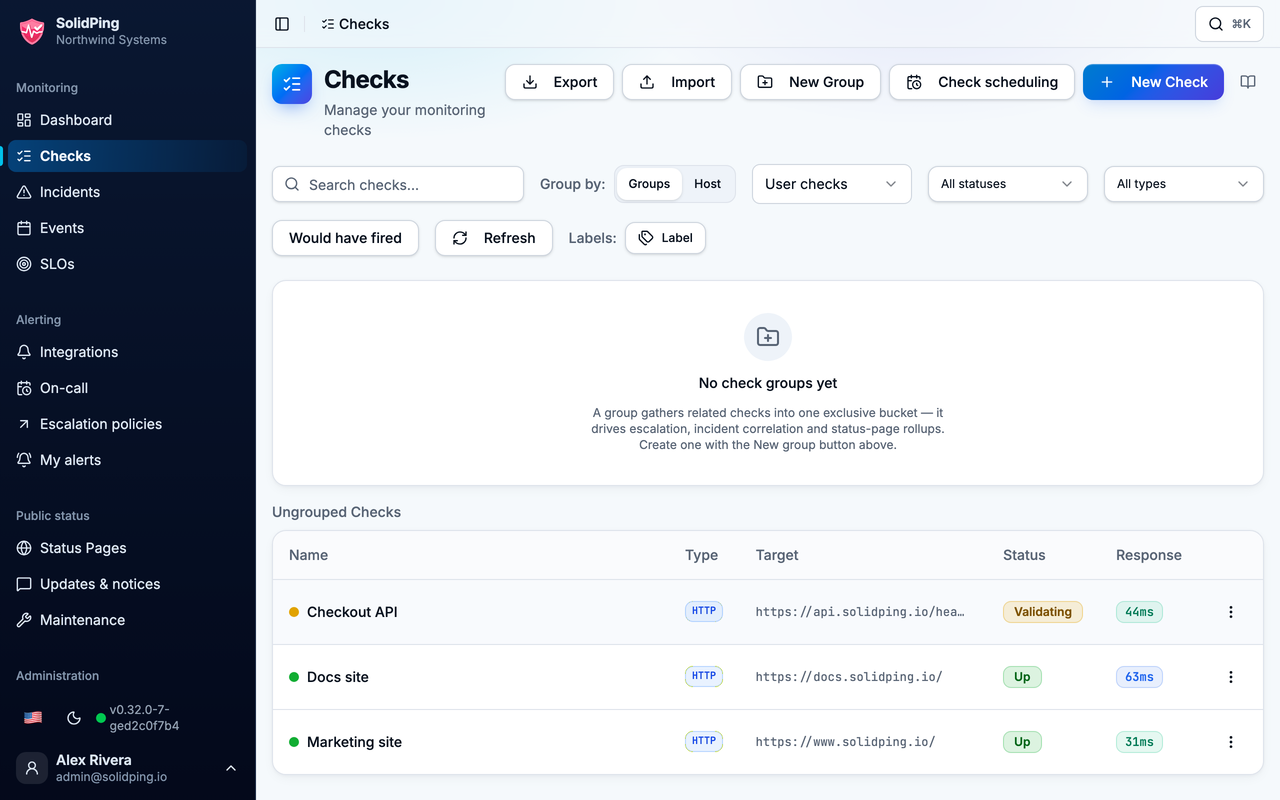 | 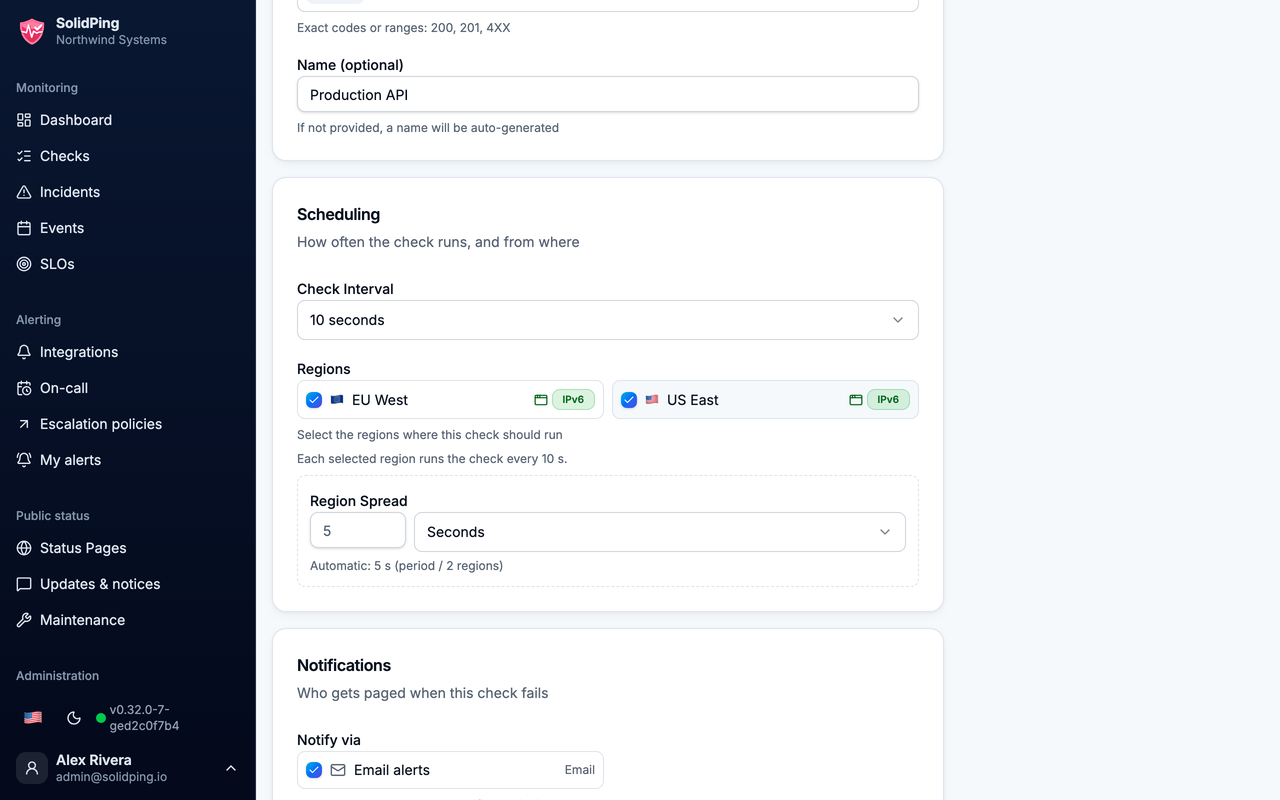 | 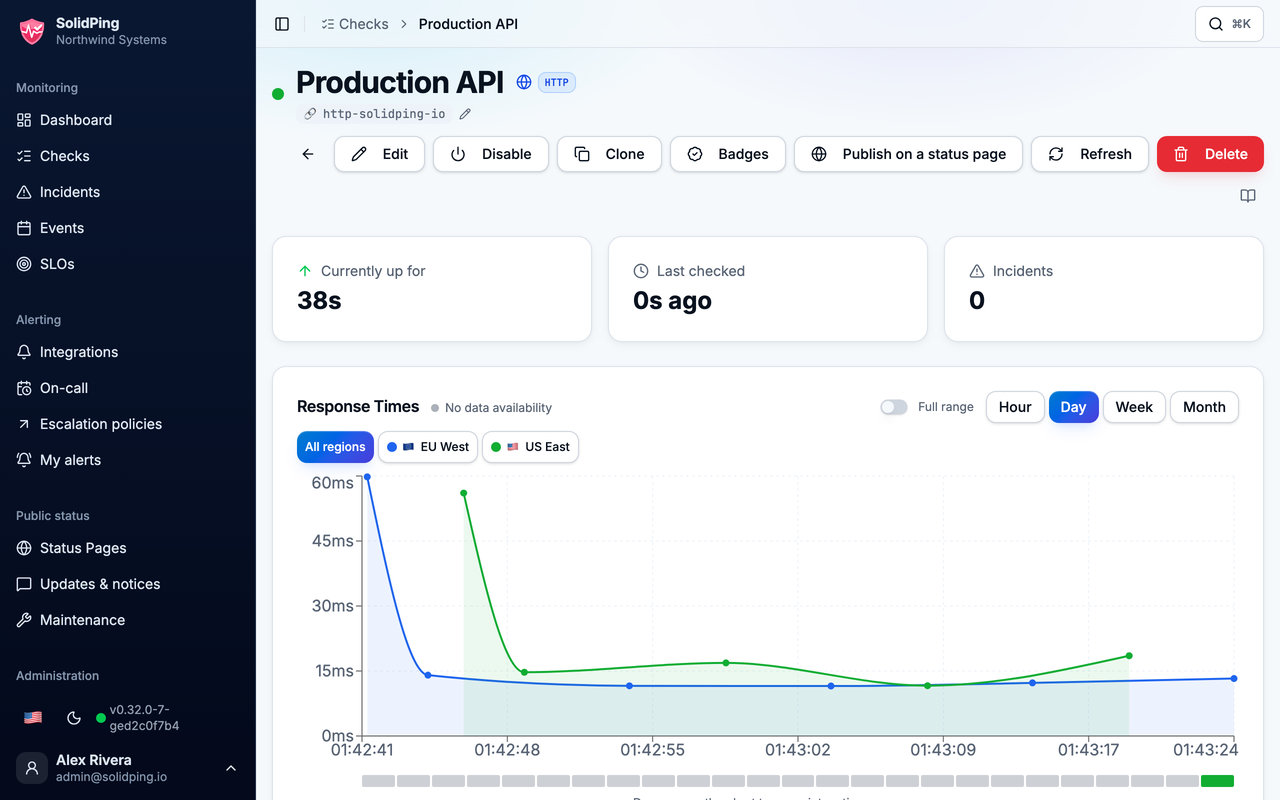 |
Check types
| Check | Type | What it checks |
|---|---|---|
| HTTP/HTTPS | http | Status codes, body, JSON and header assertions, timing breakdown |
| TCP | tcp | Port connectivity, optional send/expect payload |
| UDP | udp | Port reachability, optional send/expect payload |
| ICMP | icmp | Ping |
| DNS | dns | Record resolution |
| WebSocket | websocket | Connection handshake |
| RDP | rdp | RDP negotiation, optional authenticated logon |
| VNC | vnc | RFB handshake and authentication |
| Website crawl | crawl | Broken links, mixed content, sitemap errors |
| Application health | health | Health endpoint, reported per component |
| Vendor status page | vendor-status | Outages reported by a vendor's status page |
| SSL/TLS | ssl | Certificate validity and expiration |
| Domain | domain | Domain expiration (WHOIS/RDAP) |
| DNSBL | dnsbl | DNS blocklist membership |
| PostgreSQL | postgresql | Connection and query |
| MySQL/MariaDB | mysql | Connection and query |
| MongoDB | mongodb | Ping command |
| Redis | redis | PING command |
| MSSQL | mssql | Connection and query |
| Oracle | oracle | Connection and query |
| ClickHouse | clickhouse | Connection and query |
| SMTP | smtp | Connectivity, STARTTLS, AUTH, optional real probe email |
| IMAP | imap | Server availability |
| POP3 | pop3 | Server availability |
| Email reception | email | A known message reaches an inbox (JMAP) |
| SSH | ssh | Server availability |
| FTP | ftp | Server availability |
| SFTP | sftp | Server availability |
| gRPC | grpc | Service health |
| Kafka | kafka | Broker connectivity |
| RabbitMQ | rabbitmq | Broker connectivity |
| MQTT | mqtt | Broker connectivity |
| SIP | sip | VoIP server OPTIONS ping |
| NTP | ntp | Reachability and clock drift |
| SNMP | snmp | Device monitoring |
| Docker | docker | Container health |
| Kubernetes | kubernetes | Workload replica health |
| A2S | a2s | Source / Steam game server query |
| Minecraft | minecraft | Java and Bedrock server query |
| Freebox line | freebox_line | xDSL/FTTH line quality |
| Prometheus | prometheus | Thresholds on a scraped metric |
| Heartbeat | heartbeat | Passive: alerts when pings stop (cron jobs, CI) |
| JavaScript | js | Sandboxed scripts: multi-step API flows, logins, aggregation |
| Browser | browser | Headless Chrome: full render, screenshots |
Inspiration
- Uptime Kuma: a self-hosted monitor that is easy to run (migration guide).
- Better Stack: incidents, on-call escalation and status pages in one product (migration guide).
- Gatus: checks defined as configuration (migration guide).
- UptimeRobot: fast onboarding, one URL and you are monitoring (migration guide).
- Healthchecks.io: heartbeat monitoring for cron jobs.
- Checkly: scripted API and browser checks.
Contributing
Bug reports and pull requests are welcome. CONTRIBUTING.md covers local setup (make dev)
and PR conventions. Found a security issue? See SECURITY.md rather than opening a public issue.
License
AGPL-3.0 - See LICENSE.
Comments
New to MCP?
From what the protocol is to installing your first server, these answers cover most first questions.
An open protocol that defines how AI applications connect to external tools and data in a uniform way. Clients talk to the model; MCP servers provide tools, resources and prompt templates. They exchange standard messages, so one server can be reused by many clients.