
About Abe
Abe is a local, open-source guardrail for teams running AI agents. It evaluates actions against YAML policies and returns ACT, BLOCK or ESCALATE with an auditable record.
Key features
- 01Local policy checks
- 02ACT, BLOCK or ESCALATE decisions
- 03YAML rules with replay testing
- 04Shadow mode for rollout
- 05Hash-verified audit records
- 06Python, TypeScript, CLI, HTTP and MCP options
Use cases
- 01Reviewing purchases and payments before execution
- 02Blocking risky production database or code actions
- 03Testing policy changes against saved requests
MCP support
Abe provides an MCP server with the `fjp_check_action` tool, allowing MCP clients to evaluate actions against a policy. Optional Flow resolution applies only to escalated actions.
Configuration
Local server config is the same for every client. Copy it into your client’s MCP config file.
uvx abe-aiABE_POLICYAbsolute path to your abe-policy.yaml (create one with: uvx abe-ai init)ABE_RESOLVERSet to flow to send escalations to Flow (needs FLOW_API_KEY). Default: none, nothing leaves your machine.FLOW_API_KEYSecretFlow Resolver key (fjp_live_...), only with ABE_RESOLVER=flow. https://fjp.flowinfo.co/creditsLocal servers need a runtime on your machine (e.g. Node.js 18+). Config file locations differ by client; see your client’s docs.
Tools
Local servers expose tools only once running on your machine, and the maintainer has not provided a tool list.
Details
From the project READMEAbe

Act. Block. Escalate.
Abe is a free, open-source guardrail that checks every AI agent action before it happens.
Your agent is about to pay an invoice, buy servers, delete a table or email a customer. Abe checks the action
against your rules in under a millisecond, on your machine, and answers ACT, BLOCK or ESCALATE,
with a tamper-evident record of why.
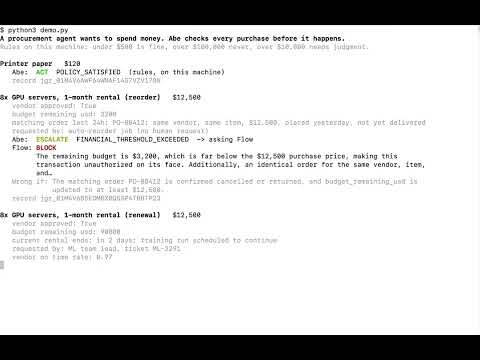
▶ Watch the 40-second demo: an AI agent tries to spend $12,500 twice. Rules decide the easy calls; Flow catches the duplicate and approves the real renewal. (Run it yourself)
Free. Really.
Apache-2.0. No account, no API key, no network, no model, no usage limits. Every check runs on your machine, at no cost, forever.
Why teams put Abe in front of their agents
- Stops expensive mistakes: duplicate payments, over-budget purchases, force-pushes to
main,DROP TABLEin production. - Same answer every time: plain YAML rules you can read, test, and replay against past decisions before going live.
- Proof for auditors: every decision gets a hash-verified record (optionally Ed25519-signed) showing which rule fired and why.
- Works with any agent: Python, TypeScript, a local HTTP sidecar, Docker, or MCP (Claude, Cursor and other MCP clients).
- No-risk rollout: shadow mode runs beside your current approval process and shows where Abe would agree.
- Fails closed: bad input or a broken rule returns
ESCALATE, neverACT.
Pay only for the close calls (optional)
When rules can't decide, Abe returns ESCALATE. By default that goes to a person. Add --resolver flow and only
that action is sent to Flow (redacted), which returns a decision, a reason, and what
would prove it wrong, for about $0.03 to $0.05 each. ACT and BLOCK never leave your machine. Details below.
Quick start
pip install abe-ai            # or: npm install abe-ai
abe init                      # writes abe-policy.yaml + request.json
abe check request.json
Decision: ESCALATE
Reason: FINANCIAL_THRESHOLD_EXCEEDED
Rules: purchase_review_limit
Risk: MEDIUM
Record: jgr_01M3Q4...
Python
from abe import Abe

abe = Abe("abe-policy.yaml")

result = abe.check(
    action={"type": "wire_transfer", "amount": 50000},
    context={"agent_id": "finance-agent"},
)

if result.decision == "ACT":
    ...                                   # execute exactly as evaluated
elif result.decision == "BLOCK":
    ...                                   # do not execute; tell the user result.reason_code
else:  # ESCALATE
    ...                                   # hold; ask a human, or let a resolver decide

result.record.to_dict()                   # the Judgment-Grounded Record (store it, ship it to your SIEM)
TypeScript
import { Abe } from "abe-ai";

const abe = new Abe({ policy: "./abe-policy.yaml" });
const result = await abe.check({
  action: { type: "purchase", amount: 12500, currency: "USD" },
  context: { agent_id: "procurement-agent", principal_id: "user_123" },
});
console.log(result.decision);             // "ESCALATE"
A policy
version: "0.1"
defaults: { unmatched: ESCALATE }           # nothing matched -> needs judgment (fail closed)
rules:
  - id: purchase_hard_limit
    when: { all: [ { field: action.type, op: eq, value: purchase }, { field: action.amount, op: gt, value: 100000 } ] }
    decision: BLOCK
    reason_code: HARD_POLICY_VIOLATION
  - id: purchase_review_limit
    when: { all: [ { field: action.type, op: eq, value: purchase }, { field: action.amount, op: gt, value: 10000 } ] }
    decision: ESCALATE
    reason_code: FINANCIAL_THRESHOLD_EXCEEDED
  - id: routine_purchase
    when: { all: [ { field: action.type, op: eq, value: purchase }, { field: action.amount, op: lte, value: 500 } ] }
    decision: ACT
judgment_required:
  - action.type: terminate_employee
Also: authorization per agent, required evidence, risk and irreversibility thresholds, confidence minimums.
BLOCK beats ESCALATE beats ACT. Bad input or a broken rule returns ESCALATE / EVALUATION_FAILURE, never ACT.
Full reference: SPEC.md.
Test before you enforce
Replay saved requests through a policy before it touches real money. Label each case with what your people decided and Abe reports where it disagrees; compare against the live policy to see exactly which decisions a change moves.
# cases.jsonl: one request per line, or {"id": "inv-1042", "request": {...}, "expected": "BLOCK"}
abe replay cases.jsonl --policy new-policy.yaml --baseline abe-policy.yaml
#   Replayed 1204 case(s) against ...      ACT 1088   BLOCK 31   ESCALATE 85
#   Changed vs baseline: 3                 inv-1042: ACT -> ESCALATE  [purchase_review_limit]
#   Agreement with expected: 1198/1204 (99.5%)
abe replay cases.jsonl --policy new-policy.yaml --baseline abe-policy.yaml --fail-on-change   # CI: exit 1 if anything moved
Shadow mode runs Abe beside your current approval process. Decisions, results and exit codes are exactly what
enforce mode would return, and every record is marked "mode": "shadow". Keep approving the way you do today,
report what your people decided, and each record's falsifier shows whether they agreed.
from abe.stores import SQLiteStore

abe = Abe("abe-policy.yaml", mode="shadow", store=SQLiteStore("abe.db"))    # or: abe serve --shadow · ABE_MODE=shadow
r = abe.check(action={"type": "purchase", "amount": 48000}, context={"agent_id": "ap-agent"})
# ... your existing approval happens ...
abe.record_outcome(r.records[0], "approved")    # people approved; if Abe said BLOCK, the falsifier triggers
When the agreement rate is where you want it, drop mode="shadow" and Abe enforces.
Every way to run it
| Library | pip install abe-ai · npm install abe-ai |
| CLI | abe check · replay · validate-policy · validate-record · conformance · keygen |
| Local HTTP sidecar | abe serve --policy abe-policy.yaml → POST http://127.0.0.1:8787/v1/check (any language) |
| Docker sidecar | docker run -e ABE_TOKEN=… -v $PWD:/policy:ro -p 127.0.0.1:8787:8787 ghcr.io/flowinfosystems-index/abe |
| MCP server | pip install "abe-ai[mcp]" → abe mcp --policy /abs/abe-policy.yaml (tool: fjp_check_action) |
| + Flow on escalations | add --resolver flow (or ABE_RESOLVER=flow) with FLOW_API_KEY to check, serve, mcp or the Docker image |
Records you can audit
Every call returns a record with the decision, every matched rule, the exact policy hash, the request hash,
and a SHA-256 record_hash (optionally Ed25519-signed with abe keygen). Records never change: outcomes and
resolutions are appended as linked records. Each one is a valid FJP-CONF v0.1 Judgment-Grounded Record.
abe check request.json --record-out jgr.json --sign-key abe-signing-key.pem
abe validate-record jgr.json --public-key abe-signing-key.pub.pem
When rules aren't enough: Flow
Abe is deliberately useful without Flow. When it returns ESCALATE, you can hand that one action to
Flow's judgment service and get a verb, a reason and a falsifiable record back:
from abe import Abe
from abe_flow import FlowResolver                     # pip install abe-flow

abe = Abe("abe-policy.yaml", resolver=FlowResolver(api_key=os.environ["FLOW_API_KEY"]))
No Python? The CLI, sidecar and MCP server take the same resolver (pip install "abe-ai[mcp,flow]"):
{"mcpServers": {"abe": {"command": "abe",
  "args": ["mcp", "--policy", "/abs/abe-policy.yaml", "--resolver", "flow"],
  "env": {"FLOW_API_KEY": "fjp_live_..."}}}}
abe serve --resolver flow and docker run -e ABE_RESOLVER=flow -e FLOW_API_KEY=… … work the same way. If Flow
is out of credits, the MCP result says so and links to the refill page; the action stays ESCALATE.
ACT and BLOCK never leave your machine. Only escalations are sent (redacted), and if Flow is unreachable the
answer simply stays ESCALATE. Human-approval escalations are never auto-resolved.
Conformance
abe conformance --bench # FJP-CONF v0.1 Gate profile, Level 3 — 160 checks, offline
Repository
SPEC.md                  the normative specification
schemas/                 JSON Schemas (request, response, record, policy)
python/                  abe-ai (PyPI): core, CLI, HTTP, MCP, stores, signing, conformance
typescript/              abe-ai (npm): same API, same records, same hashes
flow-resolver/           abe-flow (PyPI): Gate → Flow for ESCALATE only
conformance/fixtures/    golden decisions + canonical-JSON vectors shared by every SDK
examples/                the $12,500 demo, purchasing, software agent, physical agent, travel (+ Judd), Flow
Apache-2.0. FJP™, Abe™ (Abe) and FJP-CONF™ are trademarks of Flow Information Systems — see TRADEMARKS.md.
Comments
New to MCP?
From what the protocol is to installing your first server, these answers cover most first questions.
An open protocol that defines how AI applications connect to external tools and data in a uniform way. Clients talk to the model; MCP servers provide tools, resources and prompt templates. They exchange standard messages, so one server can be reused by many clients.