
About Rierino MCP Middleware
Rierino MCP Middleware exposes selected Rierino flows as MCP tools while retaining existing security policies and user roles. It can also route requests to supported protocols or third-party MCP servers, and supports distributed execution across microservices.
Key features
- 01Expose selected flows as MCP tools
- 02Retain security policies and user roles
- 03Use REST, WebSocket, or event streaming
- 04Build tools from business and data flows
- 05Enable distributed MCP execution
Use cases
- 01Make API or event-processing flows available to MCP clients
- 02Route requests to third-party MCP servers
- 03Deploy MCP handling across microservices
MCP support
Lets MCP clients invoke configured Rierino flows as tools, with access governed by existing security policies and roles. Middleware can also access third-party MCP servers based on request details.
Configuration
Local server config is the same for every client. Copy it into your client’s MCP config file.
We haven’t collected a package or remote endpoint for this server. Follow the instructions in the project README.
Tools
Local servers expose tools only once running on your machine, and the maintainer has not provided a tool list.
Details
From the project READMEMCP Server & Middleware
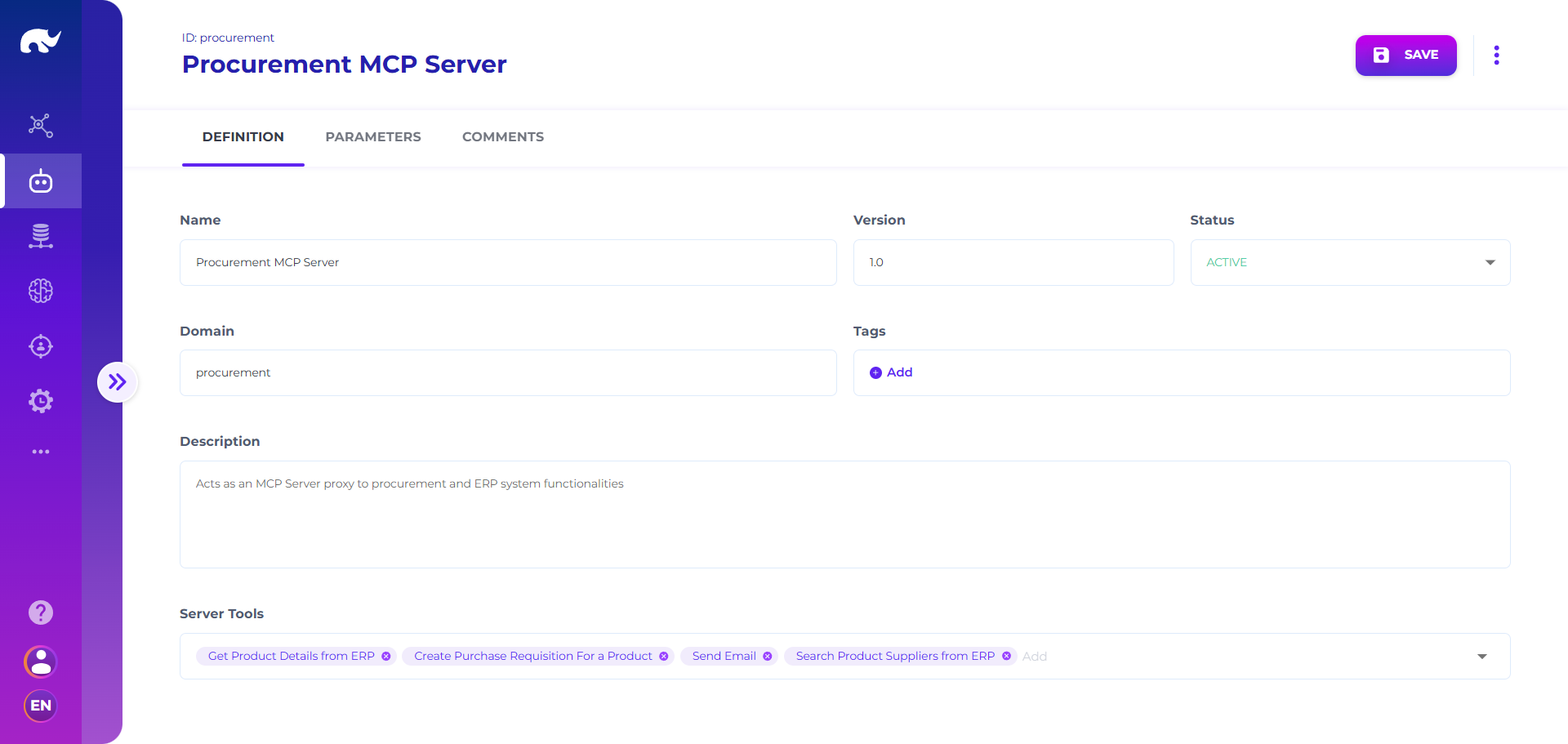
Rierino provides ability to service all of its functionality over Model Context Protocol (MCP), with a simple configuration that allows selection of flows to be serviced as tools over MCP, while maintaining already existing security policies and users roles. Any API, event processing or CDC flow can be included as MCP server tools and triggered using any protocol already supported by Rierino (e.g. REST, WebSocket, Event Streaming), going beyond the standard MCP implementations.
MCP servers can be built from scratch, using functionality such as database access, business rule evaluation, ML model prediction, external REST API calls, or could access 3rd party MCP servers acting as a middleware based on request details.
Model context protocol can be enabled on any microservice, allowing distributed execution of MCP requests in a scalable and high availability architecture by creating an Mcp Server Event Handler.
MCP server definitions allow configuration of services that are available through model context protocol through simple mapping of sagas as tools. Initial definition of a server includes:
- Name: A descriptive name
- Description: Detailed description of the server
- Tags: Descriptive tags for the server
- Status: Whether this server should be deployed or not
- Version: Current version of the server
- Domain: Categorization of the server based on business domain
- Comments: Historical list of comments, which typically includes information on server releases
- Parameters: Server asset configurations such as tools
For learning more about Rierino, please visit https://rierino.com.
Comments
New to MCP?
From what the protocol is to installing your first server, these answers cover most first questions.
An open protocol that defines how AI applications connect to external tools and data in a uniform way. Clients talk to the model; MCP servers provide tools, resources and prompt templates. They exchange standard messages, so one server can be reused by many clients.