
About Scopus Plus MCP
Scopus Plus MCP gives researchers literature search, citation-network analysis, and bibliometrics across Scopus and OpenAlex. It also audits citation links and exports data for analysis tools.
Key features
- 01Search papers, authors, and full text
- 02Build citation networks and lineages
- 03Analyze journal metrics and topic trends
- 04Audit citations and reference lists
- 05Export BibTeX and network data
Use cases
- 01Trace citation lineages for a research topic
- 02Compare journal metrics and publishing trends across fields
- 03Check citation contexts and retraction status
MCP support
As an MCP server, it exposes search, citation-analysis, audit, and bibliometrics tools to compatible clients. Clients can use Scopus and OpenAlex sources; Scopus features require the user's API key.
Configuration
Local server config is the same for every client. Copy it into your client’s MCP config file.
uvx scopus-plus-mcpSCOPUS_API_KEYSecretElsevier API key from dev.elsevier.com (required to start the server).SCOPUS_INSTTOKENSecretInstitutional token for subscriber access off campus.OPENALEX_API_KEYSecretFree OpenAlex key; raises the daily OpenAlex budget tenfold.Local servers need a runtime on your machine (e.g. Node.js 18+). Config file locations differ by client; see your client’s docs.
Tools
Local servers expose tools only once running on your machine, and the maintainer has not provided a tool list.
Details
From the project README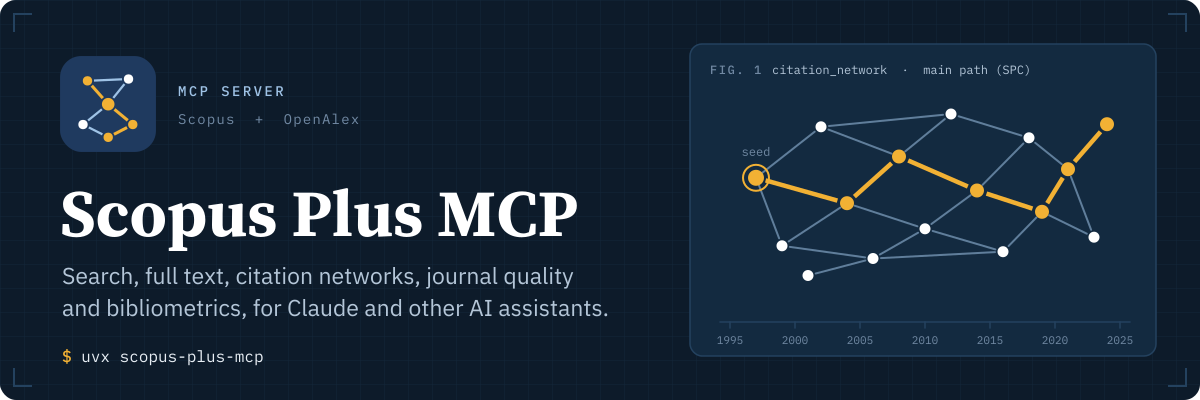


Search the literature, trace who cites whom across generations, map research fronts and intellectual bases, and pull the counts, metrics and bibliography you need, from a conversation. It is an MCP server, so any MCP client can use it: Claude Desktop, Claude Code, Cursor.
What you get
 Citation networks Coupling, co-citation, multi-generation lineages and the network within any paper set, with SPC/SPLC/SPNP main paths, key routes, RPYS and a historiograph. More |  Audited, not just built Citer sets verified across search strategies, reference lists checked against Crossref, and the sentences behind each citation. More |
 Two data sources Scopus by default. Add source="openalex" to run the same analyses without a Scopus subscription. OpenAlex topics with a field-relative journal quality cut build corpora that span disciplines. More |  Bibliometrics Where a topic is published and in which quartile, journals above a percentile cut-off, counts per year, themes over time, BibTeX. More |
 Full-text search Find Elsevier papers that use a term in their body, and see how often and where each one uses it. More |  Honest about access One call tells you which tools your Scopus access supports, and why the rest fail. More |
 Main-path skill Walks Claude from a query to a drawn main path map. Ships with the Claude Code plugin. More |  Tested 510 test functions, CI on Linux, macOS and Windows, and a live check of every tool against the real APIs. More |
How it compares with the other Scopus MCP servers and with bibliometrics packages (bibliometrix, pybliometrics, VOSviewer, Pajek): comparison.
Ask things like
Map the research front around these six papers on organizing visions.
Trace two generations of work citing Swanson & Ramiller (1997) and show me the main path.
Build the citation network of every Basket of Eight paper citing the organizing-vision papers, and show how the main path cites its predecessors.
How has publishing on "digital transformation" grown since 2010?
Build a corpus on digital transformation across IS, strategy and marketing, top-quartile journals only, and show which fields cite which.
Get SJR and CiteScore for the Basket of Eight, and BibTeX for the papers we just found.
More, with the tools each one triggers: prompt examples.
How it works
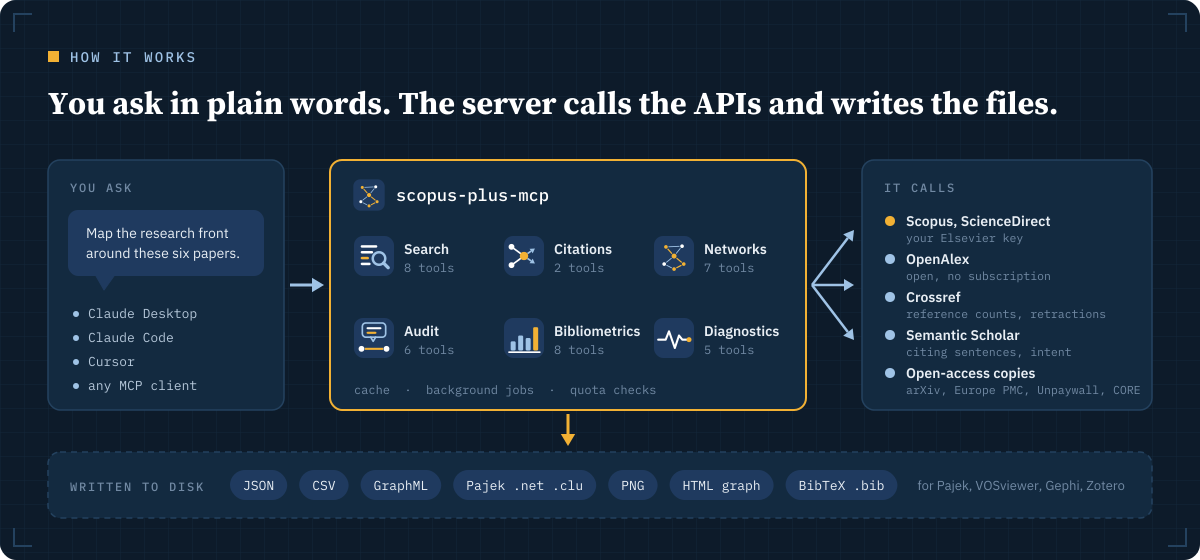
You ask in plain words and the assistant picks the tools. The server calls Scopus with your own key, and Crossref, Semantic Scholar and open-access sources where a tool needs them. Results come back as a summary in the reply, and the full data goes to files that Pajek, VOSviewer, Gephi or Zotero can open. Responses are cached, and long jobs run in the background.
Tools
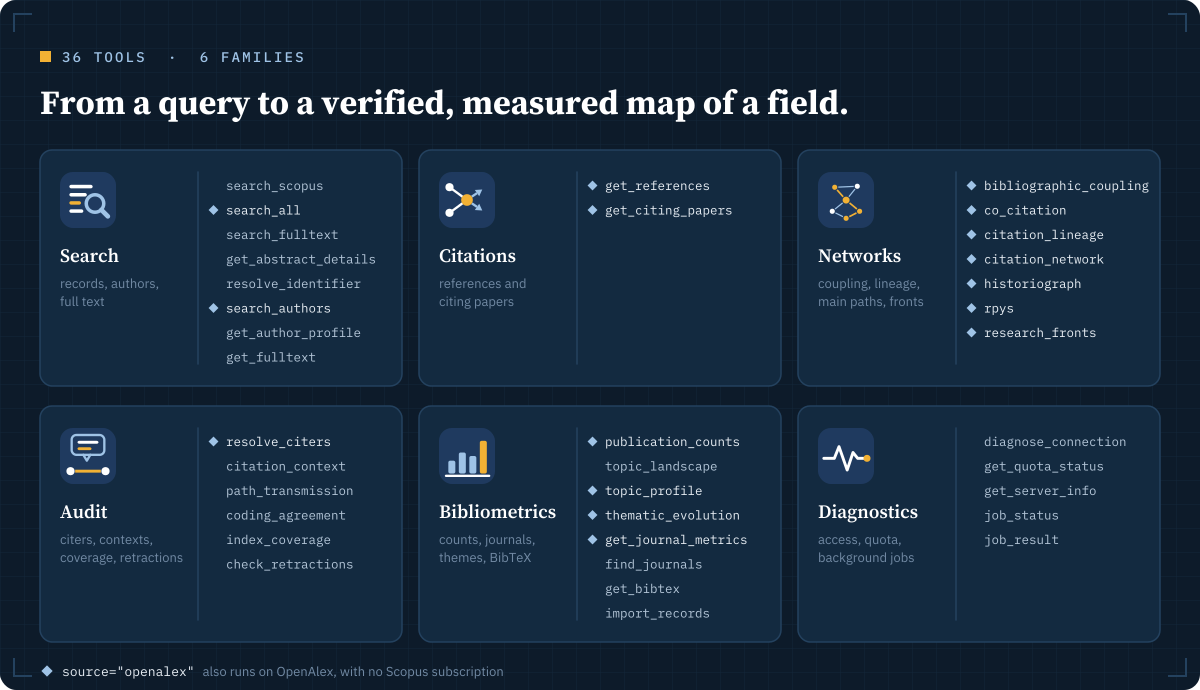
| Family | Tools | Guide | |
|---|---|---|---|
 | Search and records | search_scopus · search_all · search_fulltext · get_abstract_details · resolve_identifier · search_authors · get_author_profile · get_fulltext | search |
 | Citations | get_references · get_citing_papers | search |
| Networks | bibliographic_coupling · co_citation · citation_lineage · citation_network · historiograph · rpys · research_fronts | networks |
| Audit | resolve_citers · citation_context · path_transmission · coding_agreement · index_coverage · check_retractions | audit |
| Bibliometrics | publication_counts · topic_landscape · topic_profile · thematic_evolution · get_journal_metrics · find_journals · get_bibtex · import_records | bibliometrics |
 | Diagnostics and jobs | diagnose_connection · get_quota_status · get_server_info · job_status · job_result | access |
Every parameter of every tool: tool reference.
Install
You need an API key from the Elsevier Developer Portal (register with your institutional email). OpenAlex needs no key.
Claude Desktop, one click:
- Download
scopus-plus-mcp-<version>.mcpbfrom the latest release. - Open it (or drag it into Settings → Extensions), click Install, and paste your API key when asked. Claude stores it securely.
Claude Code, two commands:
claude plugin marketplace add michalhron/scopus-plus-mcp
claude plugin install scopus-plus-mcp@michalhron
Then make your key available, either in your shell
(export SCOPUS_API_KEY=...) or, better, in the
OS secret store.
Any other MCP client (needs uv):
{
  "mcpServers": {
    "scopus-plus": {
      "command": "uvx",
      "args": ["scopus-plus-mcp"],
      "env": { "SCOPUS_API_KEY": "YOUR_KEY" }
    }
  }
}
Then ask your assistant to run diagnose_connection. It checks your key and
tells you which tools your Scopus access supports.
The Claude Code plugin also installs the main-path skill, which walks Claude through a main path analysis from a query to a drawn map. For Claude Desktop, zip its folder and upload it as a skill.
Documentation
Feature guides:
- Search, records and full text: finding papers and authors, identifiers, importing exports, full-text search and retrieval.
- Citation networks and main paths: coupling, co-citation, lineages, main path analysis, historiograph, RPYS, research fronts.
- Audit: verified citer sets, reference-list completeness, citation contexts, the transmission audit, retractions.
- Bibliometrics and bibliography: counts per year, topic landscape, journal cut-offs and metrics, thematic evolution, BibTeX.
Reference and setup:
- Tool reference: every tool and parameter, generated from the code.
- Data sources: Scopus vs OpenAlex, when to use which, measured coverage.
- Configuration: all settings, and keeping keys in the OS secret store.
- Access and troubleshooting: off-campus access, tokens, proxies, reading
diagnose_connection. - Comparison: this project vs the other Scopus MCP servers, and vs bibliometrics packages.
- Prompt examples, development, changelog, roadmap.
Origins
Formerly citation-network-mcp (and before that michalhron/scopus-mcp). This project began as a fork of
qwe4559999/scopus-mcp by
thinktraveller and
qwe4559999, which provides Scopus search,
abstracts, author profiles and citing papers. Everything since version 0.2
was developed here by Michal Hron. MIT
licensed; see LICENSE.
Scopus and ScienceDirect are trademarks of Elsevier B.V. This project is independent and not affiliated with or endorsed by Elsevier; it uses their public APIs with your own key and subscription.
Comments
New to MCP?
From what the protocol is to installing your first server, these answers cover most first questions.
An open protocol that defines how AI applications connect to external tools and data in a uniform way. Clients talk to the model; MCP servers provide tools, resources and prompt templates. They exchange standard messages, so one server can be reused by many clients.