
About ztds
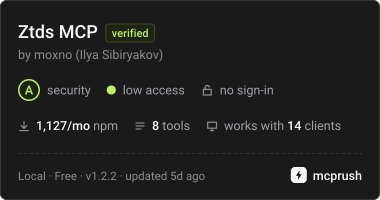
ztds implements the ZTDS RFC v1.0 MCP server and a codebase invariant-auditing CLI for teams handling sensitive data in AI workflows. It replaces sensitive text with reversible tokens in local RAM and also provides audits, protocol resources, and a prompt.
Key features
- 01In-memory masking and restoration
- 02PII, PHI, and credential audits
- 03SHA-256 receipts and risk reports
- 04MCP resources and prompt
- 05Codebase invariant auditor CLI
Use cases
- 01Mask personal data and keys before LLM processing
- 02Check text for credentials and personal information
- 03Audit codebases and enforce checks in CI
MCP support
The MCP server exposes tools for sanitization, restoration, auditing, status, and session reset, along with protocol and session telemetry resources and the ztds_guard prompt.
Configuration
Local server config is the same for every client. Copy it into your client’s MCP config file.
Tools
5Saved tool list · updated 2w ago
| Parameter | Type | Required | Description |
|---|---|---|---|
| text | string | Yes | The raw text to sanitize before sending to LLM context. |
| sessionId | string | No | Optional session identifier to preserve token consistency across conversational turns (default: "default"). |
Details
From the project READMEztds-mcp & ztds-audit — Zero-Trust Data Sanitization (ZTDS™ RFC v1.0) MCP Server & Invariant Auditor











This repository contains the official Model Context Protocol (MCP) Server implementation (ztds-mcp) and Codebase Invariant Auditor (ztds-audit) for the Zero-Trust Data Sanitization (ZTDS™ RFC v1.0) standard. Maintained by the ZTDS AI Consortium.
- MCP Server Source Code (in this repository):
packages/ztds-mcp/index.js - MCP Manifest & Server Card:
packages/ztds-mcp/manifest.json|server-card.json|smithery.yaml - MCP Server Test Suite:
packages/ztds-mcp/test.js - CLI Invariant Auditor:
bin/ztds-audit.js
ZTDS™ governs in-memory data sanitization for AI agents, IDE assistants (Claude Desktop, Claude Code, Cursor, Windsurf, Zed), retrieval-augmented generation (RAG), and Large Language Model (LLM) pipelines. It executes 100% locally in volatile device memory (RAM) with zero external network calls, zero disk writes, and zero subprocessors.
1. MCP Server Implementation (ztds-mcp)
The reference MCP server (packages/ztds-mcp/index.js) implements the Model Context Protocol (2024-11-05) over stdio JSON-RPC 2.0 transport with zero external runtime dependencies. It intercepts sensitive cleartext (PII, PHI, API secrets, IBANs, credit cards) in client RAM prior to LLM dispatch, substitutes deterministic surrogate tokens ([EMAIL_TOKEN_1], [API_SECRET_TOKEN_1]), and restores authentic values locally in LLM responses.
1.1 Installation & MCP Client Configuration
Option A: 1-Click Automated Setup
npx ztds-mcp init
Option B: Claude Desktop (claude_desktop_config.json) & Cursor IDE (.cursor/mcp.json)
{
  "mcpServers": {
    "ztds": {
      "command": "npx",
      "args": ["-y", "ztds-mcp"]
    }
  }
}
Option C: Run Directly from Repository Source
{
  "mcpServers": {
    "ztds": {
      "command": "node",
      "args": ["/absolute/path/to/ztds.ai/packages/ztds-mcp/index.js"]
    }
  }
}
Option D: Claude Code CLI
claude mcp add ztds -- npx -y ztds-mcp
1.2 MCP Tools (tools/list & tools/call)
Implemented in packages/ztds-mcp/index.js:
| Tool Name | Input Schema (properties) | Description |
|---|---|---|
ztds_sanitize | text (string, required), sessionId (string, optional) | Masks sensitive PII, PHI, and credentials in client volatile RAM with deterministic surrogate tokens ([EMAIL_TOKEN_1], [API_SECRET_TOKEN_1]) before LLM ingestion and emits a cryptographic SHA-256 ZTDS-RECEIPT-* attestation. |
ztds_restore | text (string, required), sessionId (string, optional) | Restores original unmasked cleartext from surrogate tokens locally in volatile RAM using atomic single-pass lookup (preventing second-order token injection). |
ztds_audit | text (string, required) | Audits text or file contents for exposed credentials and PII against ZTDS RFC v1.0, returning category breakdowns, risk level (LOW/HIGH/CRITICAL), and a SHA-256 compliance receipt. |
ztds_info | {} (no arguments) | Returns active ZTDS RFC v1.0 protocol status, IETF Standards Track metadata, and volatile RAM session metrics. |
ztds_reset_session | sessionId (string, optional) | Explicitly zeroizes and destroys the volatile in-memory surrogate mapping table (Theorem 2 RAM zeroization). |
Example JSON-RPC tools/call (ztds_sanitize -> ztds_restore)
Request (ztds_sanitize):
{
  "jsonrpc": "2.0",
  "id": 1,
  "method": "tools/call",
  "params": {
    "name": "ztds_sanitize",
    "arguments": {
      "text": "Customer [email protected] reported failure with key sk-proj-demo-key.",
      "sessionId": "ide-session-01"
    }
  }
}
Response:
{
  "jsonrpc": "2.0",
  "id": 1,
  "result": {
    "content": [
      {
        "type": "text",
        "text": "Customer [EMAIL_TOKEN_1] reported failure with key [API_SECRET_TOKEN_1].\n\n> [ZTDS Invariant 1 Attested] Zero external network egress.\n> Receipt: ZTDS-RECEIPT-8F4B2C19E0A3D712 | Execution: 42µs | Entities Masked: 2"
      }
    ],
    "isError": false
  }
}
1.3 MCP Resources (resources/list & resources/read)
The MCP server exposes structured read-only protocol and telemetry resources via resources/list and resources/read:
| Resource URI | MIME Type | Description |
|---|---|---|
ztds://spec/rfc-v1 | application/json | Formal ZTDS RFC v1.0 / IETF draft-sibiryakov-ztds-protocol specification metadata and the 4 core mathematical invariants. |
ztds://session/telemetry | application/json | Real-time volatile RAM session count, capacity limits, and zero-egress attestation status (zero cleartext exposure). |
1.4 MCP Prompts (prompts/list & prompts/get)
| Prompt Name | Arguments | Description |
|---|---|---|
ztds_guard | task (string, required) | Activates the ZTDS Zero-Trust Data Sanitization guardrail for the current IDE/agent workflow, instructing the model to invoke ztds_sanitize prior to external reasoning and ztds_restore on output. |
1.5 Programmatic / Node.js SDK Usage (packages/ztds-mcp/index.js)
The MCP server module exports its JSON-RPC dispatcher and in-memory sanitization primitives for direct programmatic integration and testing:
import {
  handleMessage,
  sanitizeText,
  restoreText,
  auditText,
  resetSessionStore,
  TOOLS,
  PROMPTS,
  RESOURCES
} from './packages/ztds-mcp/index.js';

// 1. Direct in-memory sanitization & restoration
const scrubbed = sanitizeText('Send wire to DE89370400440532013000 for [email protected]', 'session-1');
console.log(scrubbed.sanitizedText); // "Send wire to [IBAN_TOKEN_1] for [EMAIL_TOKEN_1]"

const restored = restoreText(`Confirmed transfer to ${scrubbed.sanitizedText}`, 'session-1');
console.log(restored.restoredText);

// 2. Direct MCP JSON-RPC 2.0 protocol invocation
const rpcResponse = await handleMessage({
  jsonrpc: '2.0',
  id: 1,
  method: 'tools/list',
  params: {}
});

// 3. Zeroize volatile session memory (Theorem 2)
resetSessionStore('session-1');
Run the MCP server verification suite locally:
node packages/ztds-mcp/test.js
2. The 4 Fundamental Invariants (RFC v1.0)
Every AI pipeline protected by ztds-mcp and audited by ztds-audit is verified against the 4 core mathematical and architectural invariants:
- Invariant 1: Zero External Egress Prior to Sanitization: Raw sensitive cleartext (PII, PHI, API secrets, private financial numbers) must never cross the local execution boundary prior to reversible surrogate tokenization.
- Invariant 2: Deterministic Reversible Tokenization: Semantic, syntactic, and structural context must be preserved for LLM reasoning while de-identification lookup tables remain strictly in local host volatile memory.
- Invariant 3: Cryptographic & In-Memory Isolation: Operations run in volatile heap or hardware-attested enclaves (WASM, Nitro Enclaves, C-ABI) with zero unencrypted disk spill and immediate memory zeroization.
- Invariant 4: Continuous Subprocessor Exclusion: Local client-side execution eliminates third-party transmission, legally exempting deployments from GDPR Article 28 data processing agreements (Zero-DPA).
3. Codebase Invariant Auditor CLI (ztds-audit)
Run a zero-install security and invariant audit across your codebase or AI agent repository:
npx ztds-audit --dir ./src --strict
Command-Line Flags
| Flag | Description | Default |
|---|---|---|
-d, --dir <path> | Target directory to audit | Current working directory |
--json | Output structured machine-readable JSON report | false |
--strict | Fail build on any low-severity or informational finding | false |
-h, --help | Display CLI options and usage | N/A |
Example Output
[ZTDS] ZTDS.ai In-Memory Codebase Auditor (RFC v1.0 Conformance)
----------------------------------------------------------------------
Directory: /home/runner/work/ai-agent/src
Files Scanned: 48 files in 18ms
Audit Hash: sha256:7f83b1657ff1fc53b92dc18148a1d65dfc2d4b1fa3d677284addd200126d9069
----------------------------------------------------------------------
[PASS] CONFORMANCE CONFIRMED: 0 INVARIANT VIOLATIONS DETECTED
All scanned files comply with ZTDS Invariant 1 (Zero-Egress) and Invariant 3 (RAM isolation).
[LEGAL STATUS] Qualifies for GDPR Article 28 DPA Exemption (Zero-Subprocessor Chain)
[PERFORMANCE] 0.00 Bytes Sensitive WAN Egress | Pure In-Memory Execution
Next Steps for Builders & Maintainers:
1. Include this audit hash in your pull request: https://ztds.ai/apply/
2. Embed your Verified Trust Badge in README.md to claim your registry backlink:
[](https://ztds.ai/registry/)
4. GitHub Actions CI/CD Integration
Enforce zero-trust data sanitization on every pull request by creating .github/workflows/ztds-audit.yml:
name: ZTDS Zero-Trust Compliance Audit

on:
  push:
    branches: [ main, master ]
  pull_request:
    branches: [ main, master ]

jobs:
  audit:
    name: Verify ZTDS RFC v1.0 Invariants
    runs-on: ubuntu-latest
    steps:
      - name: Checkout Codebase
        uses: actions/checkout@v4

      - name: Setup Node.js Runtime
        uses: actions/setup-node@v4
        with:
          node-version: '20'

      - name: Execute ZTDS Invariant Audit
        uses: moxno/ztds.ai@main
        with:
          dir: './src'
          strict: true
5. Empirical AI Safety Benchmark (Frontier LLMs)
Verify cleartext leakage prevention, bijective fidelity, and microsecond latency across OpenAI GPT-4o, Anthropic Claude 3.5 Sonnet, Google Gemini 2.0 Pro, and DeepSeek-V3:
# Execute 25 multi-domain enterprise scenarios across 4 frontier LLM families
npx ztds-bench

# Generate formal Markdown evaluation report & Ed25519 cryptographic certificate
npx ztds-bench --out-report benchmark-report.md --cert
| Frontier Model | Raw Egress (No ZTDS) | Protected Egress (ZTDS) | Leakage Prevention Rate | Bijective Fidelity |
|---|---|---|---|---|
openai/gpt-4o | 100.0% | 0.00% | 100.0% | 100.0% |
anthropic/claude-3-5-sonnet | 100.0% | 0.00% | 100.0% | 100.0% |
google/gemini-2.0-pro | 100.0% | 0.00% | 100.0% | 100.0% |
deepseek/deepseek-v3 | 100.0% | 0.00% | 100.0% | 100.0% |
Full report: ZTDS AI Safety Benchmark Report (2026)
6. Remediation & Certified Implementation Engines
| Tier | Package | License | Role & Deployment |
|---|---|---|---|
| Open Reference Core | @ztds/core (packages/ztds-core) | Apache-2.0 | Vendor-neutral in-memory TypeScript/JS baseline. Universal regex rules (Email, Phone, PAN, SSN, API Keys). Docs |
| Open Reference MCP | ztds-mcp (packages/ztds-mcp) | Apache-2.0 | Official zero-dependency reference MCP server (io.github.moxno/ztds on Anthropic Registry) for Cursor, Claude Desktop, and Zed. MCP Guide |
| Certified Pioneer SDK | @privacyscrubber/sdk | Commercial / Air-Gapped | High-throughput WASM engine with 30 Specialized Industry Profiles (HIPAA, PCI-DSS, Legal FRE-502), multi-threaded pipeline bindings, offline Ed25519 node licensing. Get SDK |
| Air-Gapped IDE MCP | @privacyscrubber/mcp-server | Commercial / Stdio | Stdio MCP proxy (io.github.moxno/privacyscrubber-mcp) for Cursor, Windsurf, Claude Code, and autonomous developer agents with 30 enterprise profiles. MCP Guide |
7. Ecosystem Demarcation & Neutrality
- ZTDS.ai (
ztds.ai): Independent, vendor-neutral open standard, certification authority, and technical consortium. Governs RFC v1.0 specifications under Apache 2.0 / CC BY 4.0. - PrivacyScrubber (
privacyscrubber.com): Commercial reference implementation and pioneer engine provider.
8. Intellectual Property & Statutory Governance
- Patent Application: U.S. & International Patents Pending (System and Method for Client-Side Zero-Trust Data Sanitization and Cryptographic Multi-Party Pipeline Handoff). Paris Convention & 35 U.S.C. § 119 Priority ().
- Registered Trademark: ZTDS™ (ILPO Order #182655957, Classes 9 & 42).
- Academic DOIs:
- Zenodo: 10.5281/zenodo.22058770
- Open Science Framework (OSF): 10.17605/OSF.IO/5BYJF
- SSRN: 7335581
- Author & Founder: Ilya Sibiryakov (BrandMeWeb)
9. License
Licensed under the Apache License, Version 2.0. Copyright 2024–2026 Ilya Sibiryakov (ZTDS AI Consortium / BrandMeWeb).
Comments
New to MCP?
From what the protocol is to installing your first server, these answers cover most first questions.
An open protocol that defines how AI applications connect to external tools and data in a uniform way. Clients talk to the model; MCP servers provide tools, resources and prompt templates. They exchange standard messages, so one server can be reused by many clients.