
About breedsim-mcp
breedsim-mcp lets AI agents run AlphaSimR breeding-program simulations. It reports replicate distributions and paired comparisons with confidence intervals, rather than returning a single stochastic run.
Key features
- 01Create founder populations and report provenance
- 02Run replicated breeding-program simulations
- 03Return per-cycle means, standard deviations, and 95% CIs
- 04Compare programs using paired differences
- 05Support phenotypic and genomic selection
Use cases
- 01Estimate outcomes across breeding-program cycles
- 02Compare two selection schemes on shared seeds
- 03Evaluate phenotypic versus genomic selection
MCP support
The MCP server exposes AlphaSimR simulation functions to AI agents, including population creation, program runs, and program comparisons. It communicates over stdio.
Configuration
Local server config is the same for every client. Copy it into your client’s MCP config file.
uvx breedsim-mcpOMP_NUM_THREADSPinned to '1' at import so AlphaSimR results are reproducible; overriding it makes runs non-deterministic and the server reports that in every response.Local servers need a runtime on your machine (e.g. Node.js 18+). Config file locations differ by client; see your client’s docs.
Tools
Local servers expose tools only once running on your machine, and the maintainer has not provided a tool list.
Details
From the project READMEbreedsim-mcp
breedsim-mcp is an MCP server that lets AI agents run AlphaSimR breeding-program simulations. It returns the spread over replicates, never a single stochastic run, so an agent can say what a selection scheme would gain and how sure that is.






Why replicates
A single simulation run is not a result, and this API will not return one. Five seeds of an
identical three-cycle program gave mean genetic gain [1.151, 1.841, 1.424, 1.429, 1.473],
sd 0.247, on the very number being reported (measured once on AlphaSimR 2.1.0 while
building v0.1.0, 2026-07-29). So run_program enforces a replicate floor and returns a
per-cycle mean, sd and confidence interval. No flag collapses it to a point estimate.
Install
This needs more than uv pip install:
- R ≥ 4.3 with a shared library (
libR.so) - AlphaSimR, an Rcpp/RcppArmadillo compile that takes minutes
libtirpc-dev, or rpy2 fails to link (cannot find -ltirpc)- rpy2
<3.6, because 3.6 bindsR_getVar, which needs R ≥ 4.4
sudo apt-get install -y r-base r-base-dev libtirpc-dev
R -e 'install.packages("AlphaSimR", repos="https://cloud.r-project.org")'
uv add breedsim-mcp
Do not use a conda Python: rpy2 then fails to load libR.so with
GLIBCXX_3.4.30 not found, because conda ships an older libstdc++ than the system
libicuuc requires. Use a system or uv-managed interpreter. Requires mcp 2.x.
Configure your MCP client
The server speaks stdio through the breedsim-mcp console script.
Claude Code
claude mcp add breedsim -- breedsim-mcp
Claude Desktop (claude_desktop_config.json):
{
  "mcpServers": {
    "breedsim": {
      "command": "breedsim-mcp"
    }
  }
}
If the executable is not on your PATH, or AlphaSimR lives in a user library, run it
through uv and pass the library path:
{
  "mcpServers": {
    "breedsim": {
      "command": "uv",
      "args": ["run", "--directory", "/path/to/breedsim-mcp", "breedsim-mcp"],
      "env": { "R_LIBS_USER": "/home/you/R/library" }
    }
  }
}
Check it with list_methods(), which reports the engine versions and whether this process
can currently produce reproducible results.
What the benchmark shows
Claude with the server was compared with Claude writing its own AlphaSimR scripts, with R and AlphaSimR installed for it, on 34 breeding-simulation questions, 3 runs each. A tie means the server matches that result without you setting up R and AlphaSimR. Questions right in every run, server against Claude's own scripts: Claude Haiku 5.5 34 against 33, Sonnet 5.5 28 against 33, Opus 5.5 34 against 34 (re-run 2026-10-18). None is separated (pre-registered; Holm-adjusted McNemar p = 1.0 on Haiku, 0.25 on Sonnet). Sonnet's gap is runs where it answered from breeder's-equation theory instead of running the simulation. The server was cheaper with Haiku (on 26 of 34 questions) and dearer with Sonnet and Opus. Opus with no tools got 51 of 102 answers right.
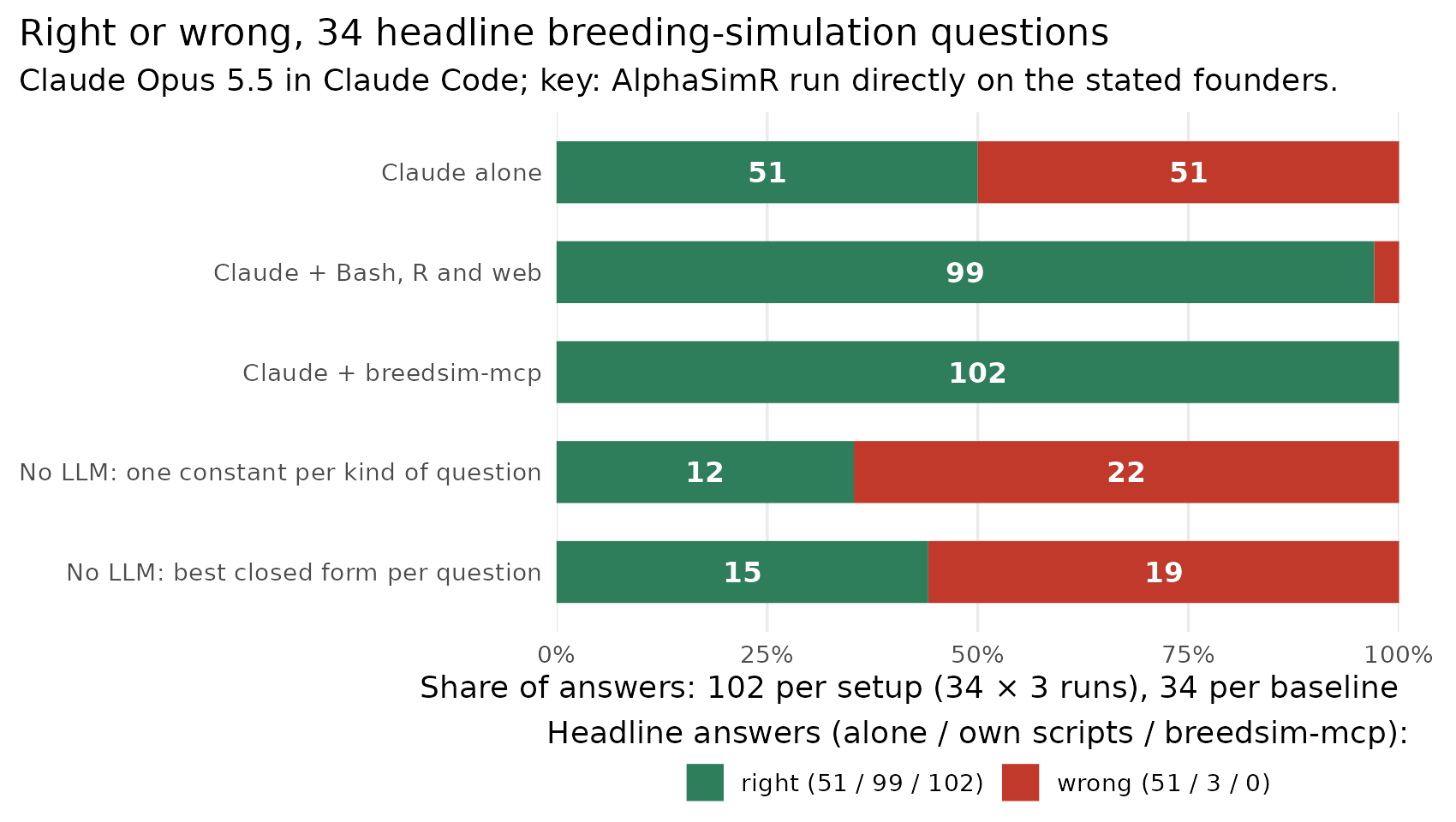
The chart is the first Opus 5.5 run, keyed by AlphaSimR run directly; the best named formula lands in only 15 of 34. With this server Claude got 102 of 102 answers right, with its own R and AlphaSimR 99 of 102 (not separated, exact McNemar p = 1.0), and alone 51 of 102 (both tool setups beat it, p < 1e-6). The re-run, with an unreleased commit that cut the server's instructions and rounded its outputs, got 102 of 102 in both setups and lowered the server's median cost per answer from $0.051 to $0.033; Claude's own scripts cost $0.027, cheaper on all 34 questions (p = 1e-10). Time is not separated.
Each question spells out the AlphaSimR calls, so this tests running a stated simulation, not designing one unaided. We wrote the questions and ran the benchmark ourselves; an outside re-run is welcome. Method, controls, other limitations, and six probability questions reported separately are in benchmarks/agent_qa; the Haiku and Sonnet runs: 2026-10-20 re-run.
Tools
| Tool | Returns |
|---|---|
list_methods | engine versions, generators, selection methods, replicate floor |
found_population | session_id, founder provenance, reproducible, measured LD |
run_program | per-cycle distributions: mean, sd, 95% CI |
compare_programs | the paired difference between two programs, with a CI |
describe_session | provenance, trait architecture, cycles run |
Typical loop: found_population → run_program → read the CI and the warnings. To compare
two schemes: found_population → compare_programs → read difference. run_program
takes selection_method="phenotypic" or "genomic"; compare_programs takes one per arm.
docs/REFERENCE.md has the full tool signatures, example outputs, the warnings table, and the measurements behind the points below.
- Compare with
compare_programs, not tworun_programcalls. It runs both arms on the same seeds and differences them within each pair, so shared luck cancels. Two overlapping per-program intervals do not imply no difference; the paired interval can still exclude zero (warningoverlap_but_different).favoursisnullwhen the paired interval contains zero. - Genomic selection needs linkage disequilibrium.
selection_method="genomic"fits RRBLUP to a SNP chip set at founding (n_snp_per_chr).quickHaplo, the default and the only reproducible generator, has no LD, so userunMacs, which does not reproduce in a long-lived process. On this engine you cannot have both.found_populationmeasures LD and warns (no_linkage_disequilibrium) when the markers are uninformative. - Reproducibility. The server pins
OMP_NUM_THREADS=1at import, before R starts; without it the same seed gives different results. TherunMacsRNG is seeded once per R session and advances across calls, so a repeat call in this long-lived process differs (reproducible: false). - Warnings explain; none of them withhold results.
- Multi-trait selection. Pass
h2as a list andindex_weightsto select on a weighted index.trait_correlationmust be a real correlation matrix (for n equally correlated traits, not below −1/(n−1)); an invalid one is refused, not replaced by the nearest valid matrix. Genomic selection fits one RRBLUP model per trait, applies the index to the estimated breeding values, and reportsprediction_accuracyin eachtraitsentry. - Species.
speciesapplies only torunMacs, which has demographic histories forGENERIC,CATTLE,WHEATandMAIZE; anything else is refused. The default isMAIZE, but this is not a plant-only simulator. - Limits. Every size parameter has a ceiling, listed by
list_methods()underlimits. R is a single interpreter and calls are serialized, so one oversized call would block every other. For large jobs, drive AlphaSimR directly.
Testing
CI installs R and compiles AlphaSimR, so the suite runs against the real engine on Python
3.11, 3.12 and 3.13. One test checks the R engine layer against the breeder's equation
R = h²S (docs/EVAL.md); it does not test this server's founding or
selection code against an outside reference. docs/MUTATION-CHECKS.md
records 25 deliberate mutants: 24 turned a test red, and one survives because it is
equivalent. tests/test_perf_ratchet.py gates each tool on exact counts of package-function
calls and R evaluations, not on time.
Limitations
compare_programsis single-trait: one paired verdict needs one criterion, and with several traits that is the index, for which AlphaSimR reports no gain.- No G×E, optimal contribution selection, crossing-block optimization or genotype-matrix export.
- Genomic selection is RRBLUP only.
RRBLUP_D,_GCAand_SCAestimate dominance and combining-ability effects that the additive-onlyaddTraitAarchitecture does not have. - Sessions are in memory, capped at 8 (LRU), and do not survive a restart.
License
GPL-3.0-or-later, because this imports rpy2, which is GPLv2+. AlphaSimR itself is MIT. Unofficial: not affiliated with, endorsed by, or sponsored by the AlphaSimR authors, the University of Edinburgh, or the R Foundation. See NOTICE.
CHANGELOG.md records what changed and why.
Comments
New to MCP?
From what the protocol is to installing your first server, these answers cover most first questions.
An open protocol that defines how AI applications connect to external tools and data in a uniform way. Clients talk to the model; MCP servers provide tools, resources and prompt templates. They exchange standard messages, so one server can be reused by many clients.