
About RepoPilot
RepoPilot is a local review tool for Git changes that helps developers and teams inspect a change before merge. It reports structural evidence and a PASS, REVIEW, BLOCK, or NOT ASSESSED decision, and analysis runs on the local machine or CI runner without sending source to a hosted service.
Key features
- 01Local deterministic review of Git changes
- 02Detects weakened tests and relaxed CI gates
- 03Flags security boundary and input-to-sink changes
- 04Analyzes direct dependents and wider file impact
- 05Reports in console, Markdown, JSON, HTML, and SARIF
Use cases
- 01Checking whether a change skipped or weakened tests before merge
- 02Gating branch reviews in CI on high-confidence signals
- 03Reviewing edits made by a coding agent since a snapshot
MCP support
RepoPilot provides a local stdio MCP server that gives an agent access to its scan and review tools.
Configuration
Local server config is the same for every client. Copy it into your client’s MCP config file.
We haven’t collected a package or remote endpoint for this server. Follow the instructions in the project README.
Tools
6Saved tool list · updated 2w ago
| Parameter | Type | Required | Description |
|---|---|---|---|
| base | string | No | Base Git ref to diff against, e.g. "origin/main". Optional; defaults to the working tree vs HEAD. |
| head | string | No | Head Git ref. Optional and only valid together with "base". |
| path | string | No | Repository path to review. Defaults to the current working directory. |
| limit | integer | No | Maximum findings to return. |
| scope | enum | No | "changed" reports findings in the changed files only; "full" also returns findings from the rest of the repository.changed | full |
| config | string | No | Optional repopilot.toml path. Defaults to the one discovered in the repository. |
| detail | enum | No | "compact" returns at most 20 findings and 20 signals; "full" returns all of them.compact | full |
| intent | object | No | Optional inline statement of what the change is meant to touch (paths, contract families, critical paths, verification IDs). The report marks drift outside it. It is metadata only and cannot execute commands. |
| intent.paths | array | No | |
| intent.summary | string | No | |
| intent.version | integer | No | |
| intent.verification | array | No | |
| intent.critical_paths | array | No | |
| intent.contract_families | array | No | |
| offset | integer | No | Zero-based finding offset. |
| verify | array | No | IDs of checks configured in repopilot.toml to request for the reviewed revision. Each needs a separate one-time user approval through form-mode Elicitation; unsupported clients skip checks. Omit to run nothing. |
| filters | object | No | Optional thresholds and rule IDs that narrow the returned findings. |
| filters.rules | array | No | |
| filters.min_priority | enum | No | p0 | p1 | p2 | p3 |
| filters.min_severity | enum | No | info | low | medium | high | critical |
| filters.min_confidence | enum | No | low | medium | high |
| profile | enum | No | "default" hides low-signal suggestions; "strict" shows all findings.default | strict |
| baseline | string | No | Optional baseline file (from `repopilot baseline create`). Findings recorded in it count as accepted debt, separate from new findings. |
| intent_path | string | No | Optional repository-rooted TOML file that states what the change is meant to touch. The report marks drift outside it. Use either this or `intent`, not both. |
| fail_on_review | enum | No | "definitely" fails the report's gate when a gate-eligible definitely-tier signal is present; "none" reports signals without gating.none | definitely |
Details
From the project READMERepoPilot


Local, deterministic review for Git changes.
RepoPilot helps developers and teams inspect a change before merge. It reports structural evidence about security boundaries, behavior, local imports and exports, and the files affected through the dependency graph. The same review can run from a terminal, in CI, or through an agent integration.
The analysis runs on the machine or CI runner that invokes it. It does not send source to a hosted service or call an embedded language model. Findings point to code and explain what to check; reviewers still decide whether a change is safe for their application.
Example: a change that weakens its own tests
This change drops a range check from applyDiscount. The same change skips the
test that would now fail, removes an assertion from another test, and lets the
CI test step fail without failing the job. Every check that still runs passes.
repopilot review . lists them right after its decision:
Decision: REVIEW (Change Proof: REVIEW)
...
Checks this change weakened (details under Review signals):
  ⚑ check gate relaxed — .github/workflows/ci.yml:10
  ⚑ assertions removed — src/pricing.test.ts:5
  ⚑ test skipped — src/pricing.test.ts:9
Further down, each signal explains itself:
    ⚑ check gate relaxed — .github/workflows/ci.yml:10  check step `npm test` in job `test` now has `continue-on-error: true`
    ⚑ assertions removed — src/pricing.test.ts:5  "applyDiscount > takes a percentage off the total": assertions 2 → 1
    ⚑ test skipped — src/pricing.test.ts:9  `it.skip` added on "rejects a discount above 100%"; its result no longer fails the run
These are excerpts of one run (recording). Replay it with
scripts/demo-weakened-tests.sh <empty-dir>, then run repopilot review <empty-dir>.
Install and review
cargo install repopilot
# or
npm install -g repopilot

repopilot review . --base origin/main
For uncommitted work, run repopilot review .. The first screen gives one
PASS, REVIEW, BLOCK, or NOT ASSESSED decision, its reasons, coverage
limits, and a next action.
A review can surface:
- changes to authentication, request trust, deployment, dependencies, or secret configuration;
- added or removed behavior such as network calls, subprocesses, filesystem writes, SQL, or error handling;
- changed input-to-sink paths, algorithmic structure, or local import/export contracts;
- tests the change stopped running or weakened: committed focus markers such as
it.only, newly skipped tests (it.skip,@pytest.mark.skip,t.Skip,#[ignore]), removed or substituted test cases, tests that lost assertions, new lint, type, or coverage suppressions, and relaxed CI or tool gates (continue-on-error,|| true, lowered coverage thresholds, strict mode off), so a green run cannot hide them; - direct dependents and the wider impact of changed files.
Signals are advisory evidence. For example, a taint-lite signal shows that a recognized input can reach a recognized sink in the changed source. Confirm the impact in the context of the application and its configured checks.
Example: review an image-processing change
The Wagtail example removes an authorization check and passes request data to a subprocess in a one-file change. RepoPilot reports both the boundary change and the input-to-process flow.
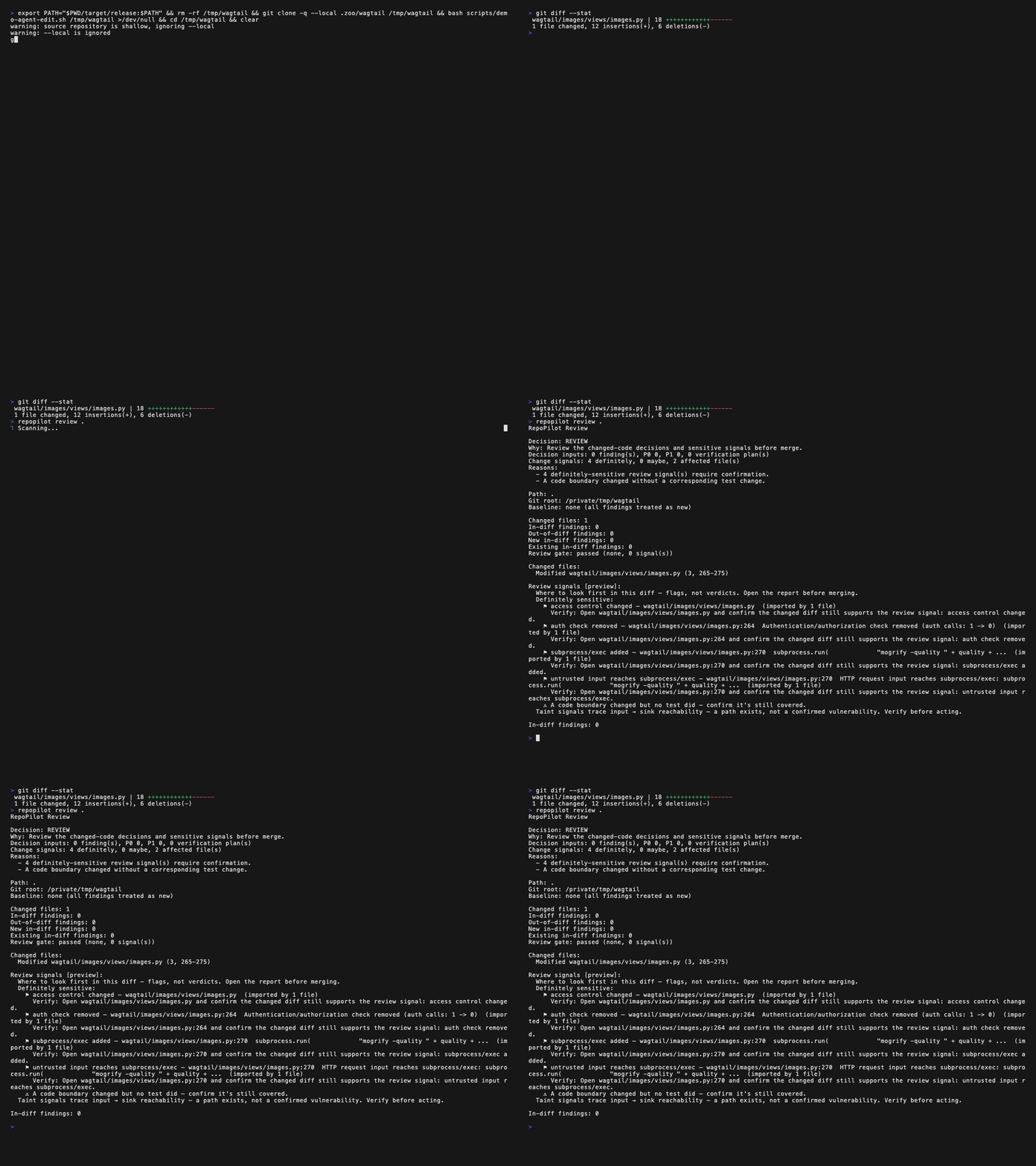
Replay the example on the pinned test repository:
python3 scripts/zoo.py clone --only wagtail
scripts/demo-agent-edit.sh .zoo/wagtail
repopilot review .zoo/wagtail
A reported flow is a path to investigate. RepoPilot does not prove that it is exploitable or that the application is safe.
Use in a team
Gate a branch review on high-confidence signals:
repopilot review . --base origin/main --fail-on-review definitely
A review is VERIFIED only when checks configured for the repository are
explicitly selected with --verify and pass on the reviewed revision. Generate
suggestions for a first setup with
repopilot init --suggestions-output repopilot-suggestions.toml; the file is
separate from active configuration. See configuration.
For a broader repository view, run repopilot scan .. Use
repopilot baseline create . to adopt existing findings before gating new work.
Agent and CI integrations
The same review can check work from a human or a coding agent. Record a starting point and review the changes made since it:
repopilot snapshot
# Work happens here.
repopilot review --since-snapshot
When the working tree is already dirty, the marker also records a baseline commit of those uncommitted files, so the later review covers only what changed after the snapshot. It shows what changed, not who changed it. See common workflows.
In Claude Code, the RepoPilot plugin runs that loop for every session and stops Claude from finishing while a test it skipped, focused, removed, or weakened is unexplained:
/plugin marketplace add MykytaStel/repopilot
/plugin install repopilot@repopilot
Codex installs the same plugin (codex plugin marketplace add MykytaStel/repopilot, then codex plugin add repopilot@repopilot). Gemini CLI installs it as an
extension (gemini extensions install https://github.com/MykytaStel/repopilot),
and Cursor runs it through project hooks. For GitHub Copilot's coding
agent and other agents, RepoPilot provides setup steps, an MCP entry, and an
AGENTS.md snippet. See Guard your agent runs.
RepoPilot also provides a local stdio MCP server and a GitHub Action. The MCP
server gives an agent access to the local scan and review tools. The Action runs
RepoPilot on the Actions runner and can publish SARIF or a pull request summary.
See Guard your agent runs, MCP server,
and GitHub integration. MCP Registry
name: mcp-name: io.github.MykytaStel/repopilot.
More capabilities
repopilot ai context .creates a local handoff with repository facts, findings, and a prioritized plan. It makes no model calls.repopilot initcreates configuration or integration files for review.- Reports are available as console, Markdown, JSON, HTML, and SARIF.
Documentation
- Install · Common workflows · CLI reference
- Current architecture · Reports and schemas · Security model
- Language support · Rules reference · Roadmap
- Latest stable release notes · Release evidence · Maintainer documentation
Contributing and development setup: CONTRIBUTING.md.
License
Licensed under either of Apache License, Version 2.0 or MIT license at your option.
Comments
New to MCP?
From what the protocol is to installing your first server, these answers cover most first questions.
An open protocol that defines how AI applications connect to external tools and data in a uniform way. Clients talk to the model; MCP servers provide tools, resources and prompt templates. They exchange standard messages, so one server can be reused by many clients.