
About Pi Durabletask MCP
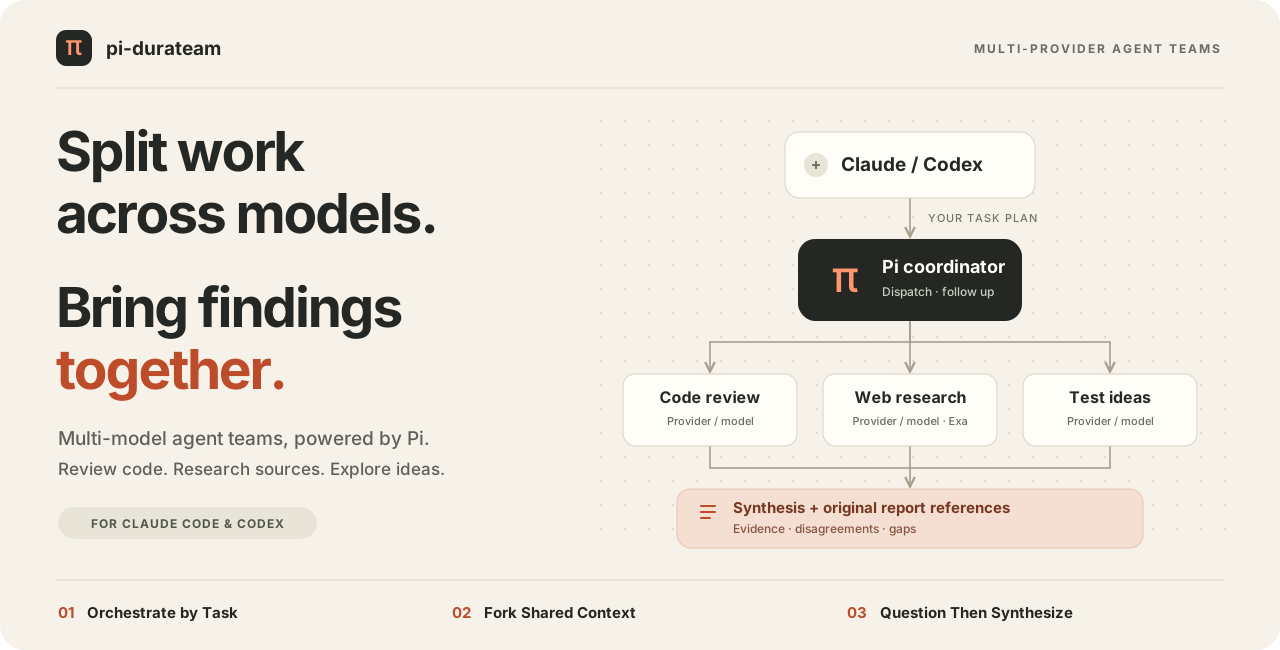
Pi Durabletask MCP, now installed as pi-durateam, connects Claude Code and Codex with teams of Pi delegates across providers. It supports parallel model work, task steering, and optional durable sessions, while returning compact reports to the main agent.
Key features
- 01Run delegate tasks individually or in parallel
- 02Send one prompt to multiple models
- 03Fork completed sessions for further questions
- 04Steer, continue, or stop running tasks
- 05Set run budgets and optional recovery
Use cases
- 01Review a code diff with several models
- 02Delegate repository research and cross-checking
- 03Continue a task after a server restart
- 04Collect longer reports as files
MCP support
Runs as an MCP server for Claude Code and Codex, exposing tools to spawn, monitor, steer, and collect Pi delegate tasks. Delegates can be granted selected tools from MCP servers configured in Pi.
Configuration
Local server config is the same for every client. Copy it into your client’s MCP config file.
Tools
14Saved tool list · updated 1w ago
| Parameter | Type | Required | Description |
|---|---|---|---|
| cwd | string | No | Repository you intend to delegate in; picks up its project-local pi model scope |
| models | string | No | Substring to filter the model list, e.g. "deepseek" |
Details
From the project README
English · 简体中文
pi-durateam
A team of Pi agents for Claude Code and Codex, on any provider, with runs built to finish.




Quick start · Team · MCP tools · Dura · Reference
Renamed from
pi-durabletask-mcp: installpi-durateam. The old command still works; configuration,PI_DELEGATE_*variables, stored state and tool names are unchanged.
Your main agent plans, picks the models and judges the results. The reading, searching and cross-checking run on Pi delegates — Gemini, Grok, GPT, DeepSeek or any other provider Pi supports — and spend those quotas instead of your Claude Code or Codex one; what comes back is a compact status and the final report, or just a file path. In our own pre-release review, four agents read about two million tokens of this codebase on Gemini, Grok and a GPT model, and our Claude session received about 7 KB of reports.
- team — one task or several in parallel, the same question to several models, forks that read once and answer many questions, an opt-in coordinator, and MCP servers (read-only GitHub, a browser) granted per delegate.
- dura — every run has turn, time and tool-call budgets and a last turn without tools, reserved for the answer. Opt in to a soft deadline, model fallback on provider errors, and sessions that survive a server restart.
For example, ask your agent: "Use Pi to review the attached diff with Gemini, Grok and GPT in parallel. Don't edit files. Report only real defects with file:line." It calls spawn_batch with one shared prompt and three models, collects with wait, and gets three independent reports with token usage and cost.
Quick start
Requires macOS or Linux, Node.js 22.19+ and Pi. CI runs Node.js 22 and 24 against Pi 1.0.0, 1.0.4, 1.1.0 and 1.3.0. Model calls use your own provider credentials.
1 · Install Pi (skip if you have it) and log in to a provider:
curl -fsSL https://pi.dev/install.sh | sh
pi  # then /login, or configure a provider
2 · Install pi-durateam:
npm install -g pi-durateam@latest
Or install from source
git clone https://github.com/Nyarlathoteppppp/pi-durateam.git
cd pi-durateam && npm ci && npm run build
# below, use `node /absolute/path/pi-durateam/dist/index.js` instead of `pi-durateam`
3 · Connect. Claude Code:
claude mcp add --scope user pi -- pi-durateam
Codex (~/.codex/config.toml):
[mcp_servers.pi]
command = "pi-durateam"
The Codex desktop app starts MCP servers with a minimal PATH (no Homebrew or nvm directories), so it may find neither pi-durateam nor the node it runs on. The server then never starts and the session simply has no Pi tools. Use absolute paths there:
[mcp_servers.pi]
command = "/opt/homebrew/bin/node" # output of `which node`
args = ["/opt/homebrew/lib/node_modules/pi-durateam/dist/index.js"] # under `npm root -g`
[mcp_servers.pi.env]
PATH = "/opt/homebrew/bin:/usr/local/bin:/usr/bin:/bin" # inherited by what the server starts
Reconnect the MCP server after updating pi-durateam or Pi. Other clients →
4 · Try it: "Use Pi to check the auth module for missing permission checks. Read only." init shows models, provider credentials and settings; models lists what delegates may use.
Optional: install the Agent Skill
The skill teaches your agent the workflow. Put SKILL.md in your client's skills directory:
dir="$HOME/.claude/skills/pi-durateam" # Claude Code
# dir="$HOME/.agents/skills/pi-durateam" # Codex: use instead
mkdir -p "$dir"
curl -fsSL https://raw.githubusercontent.com/Nyarlathoteppppp/pi-durateam/main/skills/pi-durateam/SKILL.md \
  -o "$dir/SKILL.md"
Team: several models on one job
- Delegate.
spawnstarts one task in the background and returns asessionIdat once.spawn_batchstarts up to 4 per call by default (PI_DELEGATE_BATCH_MAX) and checks every task first, so nothing starts if one is bad.runblocks, for quick questions. Collect withwaitanduntil: "settled". - One question, several models. A batch-level
promptgoes to every task; each task names itsmodel, and its ownpromptis appended. Different model families miss different things, but agreement is not proof: verify findings before acting. - Read once, ask many.
forkFromstarts new tasks from a finished session's transcript, including the files it already read; each fork gets fresh budgets. - Steer and continue.
steera running delegate,answerits questions,follow_upa finished one (it keeps what it read),abortwhen needed.statusreportsidleMsandphase, which tell slow reasoning from a hung request. - Material in, reports out.
attachmentspasses a diff or notes by absolute path;saveTo/saveDirwrite long reports to files and return the path;usagegives tokens and cost. - Coordinator (opt-in). Pass a
coordinatorplan tospawn: a Pi coordinator dispatches your members, can ask one a targeted follow-up, and writes one synthesis that cites the original reports. RequirescodemodeinPI_DELEGATE_ALLOW_TOOLS. For most workspawn_batchand your own judgment are simpler. Workflow →
MCP tools per delegate
A delegate can use MCP servers from Pi's mcp.json — read-only GitHub, Serena, a browser, web search — selected per task; nothing is on by default. Add the server to ~/.pi/agent/mcp.json, permit its exact tool names in pi-durateam's environment (PI_DELEGATE_ALLOW_TOOLS="mcp__github__get_file_contents,mcp__github__search_code") and reconnect. Then select them per call:
{
  "cwd": "/absolute/repo",
  "nativeMcp": true,
  "mcpServers": ["github"],
  "tools": ["mcp__github__get_file_contents"],
  "prompt": "Read package.json of OWNER/REPO with GitHub MCP and report its version."
}
- Only the servers in
mcpServersare connected. Of their tools, the delegate gets only themcp__<server>__<tool>names listed intoolsand permitted byPI_DELEGATE_ALLOW_TOOLS; selecting a server never grants all of its tools. - A call that selects servers but grants none of their tools is refused before anything starts — for example with
toolsomitted (the read-only default), or with onlycodemodeortool_search, which reach only tools named intools.tools: []remains a tool-free run. - The server's
exposureinmcp.jsondoes not matter to delegates: every tool named intoolsis declared to the delegate directly, so you can keep serversdeferredorcodemodethere for interactive Pi. Tools set tohiddenstay unreachable. Addcodemodetotoolsonly for scripted loops; scripts reach the same named tools. extensionscan stayfalse. Batch tasks inheritnativeMcpandmcpServers; coordinator members select their own.- A permitted MCP tool may write or act outside
cwd, and the secret-path guard does not cover external servers. Grant capabilities deliberately.
Setup for GitHub, Serena and agent-browser: optional tools. Web search: research. Details and recovery: native MCP.
Dura: runs built to finish
Always on
- Turn, time and tool-call budgets.
spawnandspawn_batchdefault to 30 turns and 10 minutes,runto 12 turns and 5 minutes; the ceilings arePI_DELEGATE_MAX_TURNS(default 50) andPI_DELEGATE_MAX_DURATION_MS(default 15 minutes).maxToolCallscaps the delegate's own calls. - At 75% of the turn or tool-call budget, or after 2/3 of the time, the delegate is told to wrap up; its last turn has no tools and is reserved for the answer.
answerStateflags an empty (missing) or cut-off (partial) answer. A run that ends without an answer (aborted,error) returns its latest substantial text assalvagedText. Finished results name the model that answered.
Opt-in
- Soft deadline (
PI_DELEGATE_DEADLINE_GRACE_MS): at the deadline the tools go, no new tool call starts, and the delegate has this long to answer; only a run still without an answer is aborted. - Model fallback (
PI_DELEGATE_FALLBACK_MODELS, orfallbackModelsper call): after a provider error that outlasts Pi's retries, the run continues in the same session on the next model listed, e.g."xai/*:high,antigravity/gemini-*". In our use, a Codex quota error now continues on Grok within seconds. - For models that keep calling tools:
PI_DELEGATE_ANSWER_GRACE=1gives one more tool-free turn,PI_DELEGATE_TOOL_CHOICE_NONEsendstoolChoice: "none"on that turn,PI_DELEGATE_FINISH_THINKINGlowers the thinking level once a run is wrapping up. - Durable sessions (
durable: true): SQLite checkpoints; after a server restart the session resumes with its id, history and budgets, and a tool call whose outcome is unknown is never blindly replayed. Finished ones are kept for 7 days by default (retentionDays,PI_DELEGATE_RETENTION_DAYS). handoff:savea note in one Claude/Codex window,readit in another to continue the same durable session.
Safe defaults
- A call that omits
toolsgets the read-only set (read,grep,find,ls, or yourPI_DELEGATE_DEFAULT_TOOLS); anything more must be permitted withPI_DELEGATE_ALLOW_TOOLS. This is not a sandbox: a delegate givenbashcan do anything you can. - Secret paths (
.env,~/.ssh, credentials) are refused for attachments, reads and searches;PI_DELEGATE_SECRET_GUARD=0turns this off. - Sessions live in memory and end with the MCP process. Durable storage, fallback, the soft deadline, the answer grace turn, native MCP and the coordinator are off unless you turn them on.
- By default at most 4 delegates run at once per server process (
PI_DELEGATE_MAX_CONCURRENT). A model name that does not resolve is refused, never replaced by the default.
Documentation
- Reference: tools, configuration, authentication, native MCP
- Optional MCP tools · Web research · Review and synthesize · Coordinator
- Development · Changelog · Issues
MIT · Built on howznguyen/pi-delegate-mcp and Pi Durable.
Comments
New to MCP?
From what the protocol is to installing your first server, these answers cover most first questions.
An open protocol that defines how AI applications connect to external tools and data in a uniform way. Clients talk to the model; MCP servers provide tools, resources and prompt templates. They exchange standard messages, so one server can be reused by many clients.