
About prismAId MCP
prismAId MCP is the MCP server for prismAId, a set of open science tools that use generative AI for systematic, protocol-based literature reviews. It targets researchers who need repeatable screening and analysis of papers without writing code. The server lets an AI assistant drive the full review workflow, including protocol conformance checks.
Key features
- 01Screening, deduplication and off-topic detection
- 02Downloads papers from Zotero or URL lists
- 03Converts PDF, DOCX and HTML to plain text
- 04Runs reviews from TOML configuration files
- 05Checks RevAIse records against PRISMA 2020
Use cases
- 01Driving a systematic review through an AI assistant
- 02Checking review records against PRISMA 2020 requirements
- 03Screening and analyzing large sets of papers
MCP support
The server exposes prismAId's tools to MCP clients, so an AI assistant can run screening, download, conversion and review steps in conversation.
Configuration
Local server config is the same for every client. Copy it into your client’s MCP config file.
docker run -i --rm ghcr.io/open-and-sustainable/prismaid-mcp:0.17.1Local servers need a runtime on your machine (e.g. Node.js 18+). Config file locations differ by client; see your client’s docs.
ghcr.io/open-and-sustainable/prismaid-mcp:0.17.1stdioTools
Local servers expose tools only once running on your machine, and the maintainer has not provided a tool list.
Details
From the project README prismAId
Open Science AI Tools for Systematic, Protocol-Based Literature Reviews
prismAId offers a suite of tools using generative AI models to streamline systematic reviews of scientific literature.
It provides simple-to-use, efficient, and replicable methods for screening and analyzing research papers with no coding skills required.







Toolkit Overview
prismAId offers a comprehensive set of tools for systematic literature reviews:
Core Tools
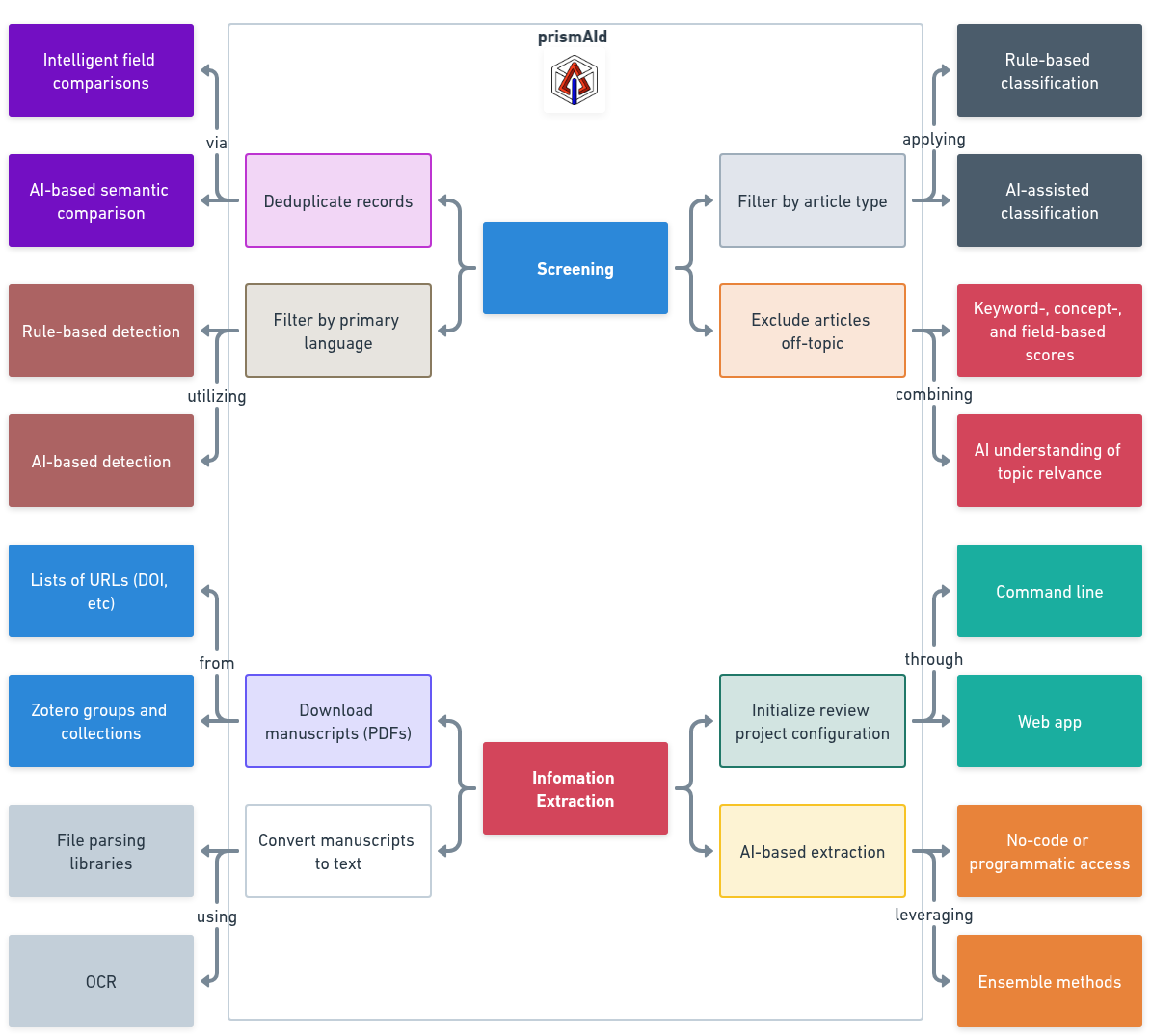
- Screening - Filter and tag manuscripts to identify items for exclusion
- Download - Download papers from Zotero collections or from URL lists
- Convert - Convert files (PDF, DOCX, HTML) to plain text for analysis
- Review - Process systematic literature reviews based on TOML configurations
- RevAIse documentation support - Optionally document review stages as RevAIse review records
Workflow
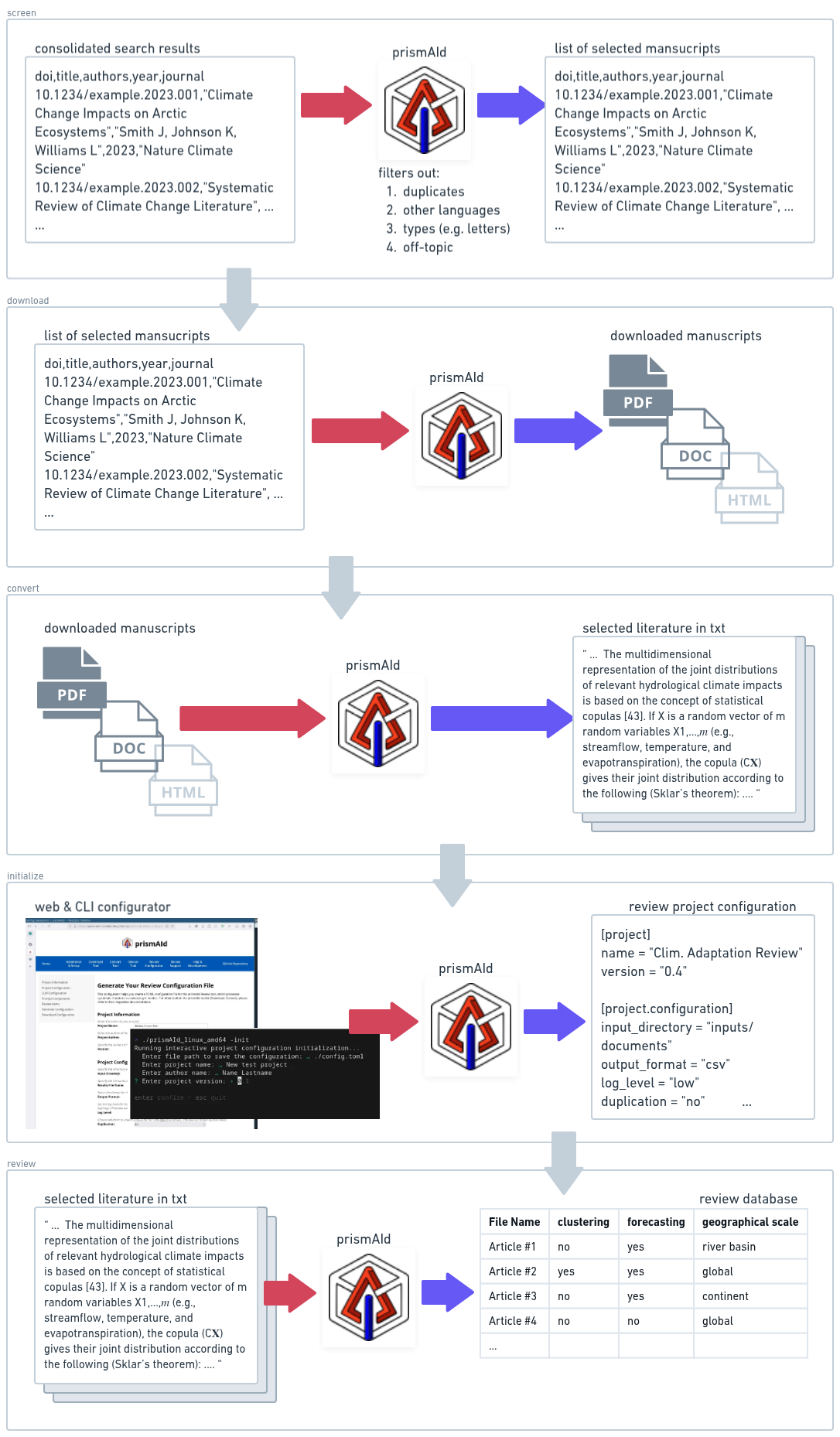
Our tools support a comprehensive systematic review workflow following the standard sequence: Search → Screen → Download → Convert → Review. RevAIse support can document Zotero download, screening, and review/extraction stages in one cumulative review record.
Access Methods
- AI agents via the MCP server - A main entry point: connect an AI assistant to the prismAId MCP server and drive every tool in conversation
- Command Line Interface - For users who prefer terminal-based workflows
- Web Initializer - A browser-based setup tool for configuring reviews
- Programming Libraries - API access through multiple languages:
- Go (native implementation)
- Python package
- R package
- Julia package
Specifications
- Review protocol: Supports any literature review protocol with a preference for PRISMA 2020, which inspired our project name.
- Review documentation: Optional RevAIse review-record support with cumulative updates and automatic backups; see the RevAIse integration guide.
- Protocol conformance: Check RevAIse review records against reporting protocols such as PRISMA 2020, and get a protocol's full requirement checklist, using the SHACL shapes published by RevAIse; see the conformance and guidance docs.
- Distribution: Available as:
- Supported LLMs:
- OpenAI: GPT-3.5 Turbo, GPT-4 Turbo, GPT-4o, GPT-4o Mini, GPT-4.1, GPT-4.1 Mini, GPT-4.1 Nano, GPT-5, GPT-5.1, GPT-5.2, GPT-5 Mini, GPT-5 Nano, o1, o1 Mini, o3, o3 Mini, and o4 Mini
- GoogleAI: Gemini 1.5 Pro, Gemini 1.5 Flash, Gemini 2.0 Flash, Gemini 2.0 Flash Lite, Gemini 2.5 Pro, Gemini 2.5 Flash, Gemini 2.5 Flash Lite, Gemini 3 Pro Preview, and Gemini 3 Flash Preview
- Cohere: Command, Command Light, Command R, Command R+, Command R7B, Command R (August 2024), Command A, and Command A Reasoning
- Anthropic: Claude 3 Sonnet, Claude 3 Opus, Claude 3 Haiku, Claude 3.5 Haiku, Claude 3.5 Sonnet, Claude 3.7 Sonnet, Claude 4.0 Sonnet, Claude 4.0 Opus, Claude 4.5 Opus, Claude 4.5 Sonnet, and Claude 4.5 Haiku
- DeepSeek: DeepSeek Chat v3, and DeepSeek Reasoner v3
- Perplexity: Sonar, Sonar Pro, Sonar Reasoning Pro, and Sonar Deep Research
- Cloud Providers: AWS Bedrock, Azure AI, Vertex AI
- Self-Hosted: OpenAI-compatible endpoints
- Screening capabilities: Deduplication, language filtering, article type classification, and off-topic detection
- Output format: Data in CSV or JSON formats
- Performance: Efficiently processes extensive datasets with minimal setup and no coding required
- Programming Language: Core implementation in Go with bindings for Python, R, and Julia
Documentation
All information on installation, usage, and development is available at prismaid.review and in the prismAId User Manual.
Credits
Authors
Riccardo Boero - [email protected]
Acknowledgments
This project was initiated with the generous support of a SIS internal project from NILU. Their support was crucial in starting this research and development effort. Further, acknowledgment is due for the research credits received from the OpenAI Researcher Access Program and the Cohere For AI Research Grant Program, both of which have significantly contributed to the advancement of this work.
License
GNU AFFERO GENERAL PUBLIC LICENSE, Version 3

Contributing
Contributions are welcome! Please follow guidelines at https://github.com/open-and-sustainable/prismaid?tab=contributing-ov-file.
Citation
Boero, R. (2024). prismAId - Open Science AI Tools for Systematic, Protocol-Based Literature Reviews. Zenodo. DOI: 10.5281/zenodo.11210796
Comments
New to MCP?
From what the protocol is to installing your first server, these answers cover most first questions.
An open protocol that defines how AI applications connect to external tools and data in a uniform way. Clients talk to the model; MCP servers provide tools, resources and prompt templates. They exchange standard messages, so one server can be reused by many clients.