
About review-assist-mcp
review-assist-mcp turns coding-agent sessions into reviewable intent documents, validating them against the diff before writing. It is for teams that need the reasoning behind code changes; the server supplies session and diff evidence without calling a model.
Key features
- 01Read session transcripts and code diffs
- 02Page through transcripts and diffs
- 03Separate author and reviewer tool access
- 04Check coverage, staleness, and references
- 05Write .intent/ files after consent
Use cases
- 01Explain change intent in pull requests
- 02Check that substantive hunks are explained
- 03Review session evidence before document submission
MCP support
As an MCP server, it provides coding agents with tools to read sessions, inspect diffs, record interview exchanges, and submit intent documents. It enforces separate tool access for author and reviewer roles.
Configuration
Local server config is the same for every client. Copy it into your client’s MCP config file.
Tools
23Saved tool list · updated 6d ago
This tool takes no parameters.
Details
From the project READMEreview-assist-mcp
Turn an AI coding agent's session into a reviewable Intent Document — the problem it was really solving, the assumptions it made, the approaches it rejected, and an anchored walkthrough of every change — validated against the diff before it is written.
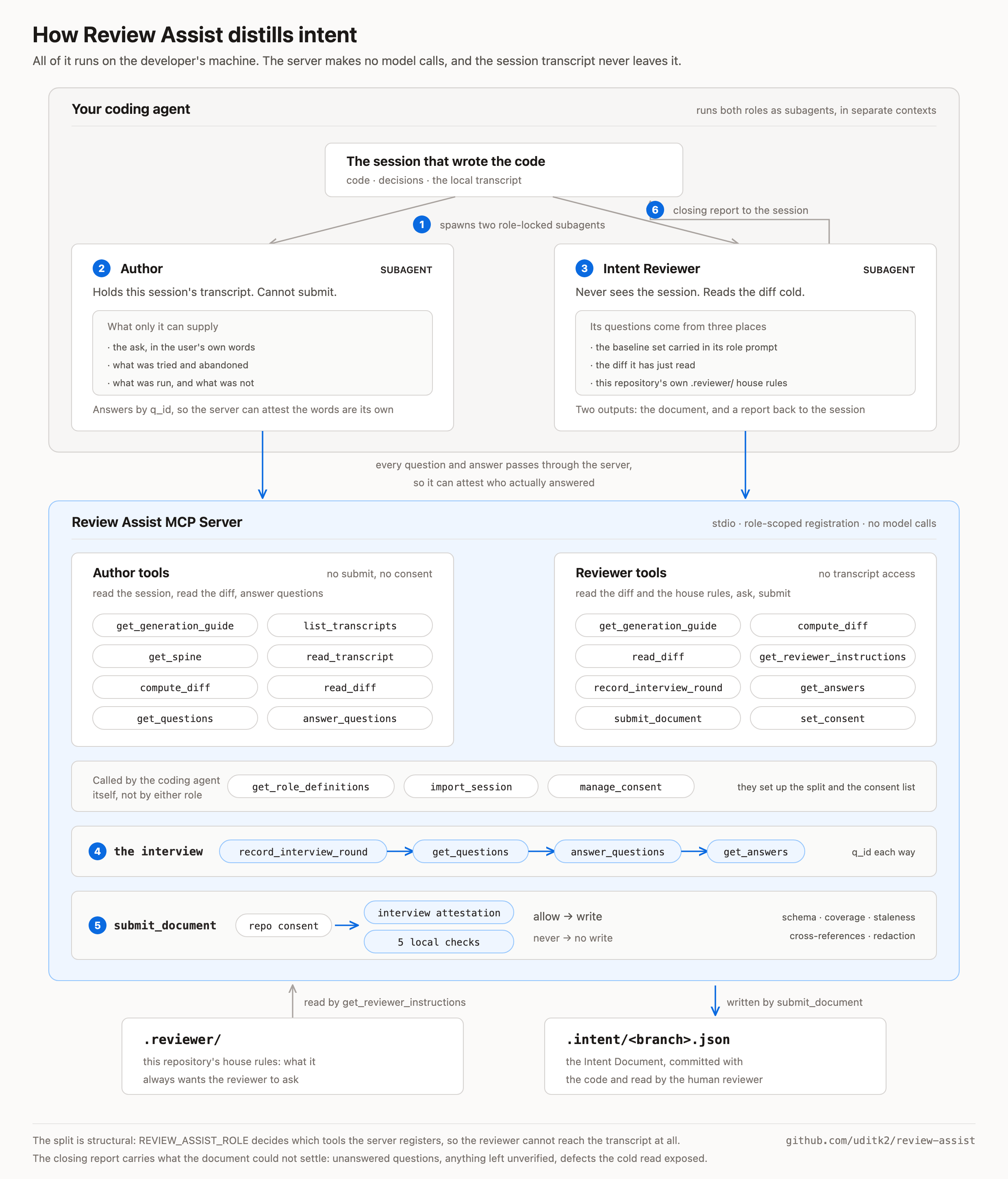
This server never calls a model. Generation is the calling agent's job; the server supplies ground truth (the diff, the transcript), enforces the role split, and gatekeeps the result.
Breaking in 0.3.0 —
compute_diffno longer returns the diff text. It returns the run handle, the numbered hunk index and the SHAs; the change itself now comes fromread_diff, a page at a time. The two used to travel together, and on a 205,826-byte change that response reached 234,337 characters — past the client's tool-result cap, so it was spilled to a file whole and the twelve characters ofrun_idwent with it, leaving a reviewer (which has no file access by design) unable to record a round or submit anything. No response grows with the size of the change any more. Upgrade the server and reinstall the role definitions; nothing about the Intent Document changes.
Review Assist is two installs
This package is one half. Installed alone it will author and validate Intent Documents locally, and that is all.
1. This MCP server — so your agent can author the document.
claude mcp add -s user review-assist -- npx -y review-assist-mcp   # Claude Code
codex mcp add review-assist -- npx -y review-assist-mcp            # Codex
Claude desktop app: download the .mcpb and open it. No terminal.
Using the VS Code extension, or a GUI-launched editor? Register it without
npx. GUI apps on macOS get only/usr/bin:/bin:/usr/sbin:/sbin, so a Homebrew/nvmnpxis not on the path, and on Windowsnpxis a.cmdwrapper that fails silently without a TTY. Either way the server shows as not connected with no error. Invokingnodedirectly avoids both:npm install -g review-assist-mcp claude mcp add -s user review-assist -- "$(which node)" "$(npm root -g)/review-assist-mcp/dist/index.js"Both
$(...)expand on your machine, so this is correct for Homebrew, nvm, fnm, Volta and Linux alike. If you use nvm and later switch Node versions, re-run it.To avoid the global install, launch VS Code from a terminal with
code .so it inherits your shell'sPATH;npxthen works. That is a habit rather than a setting — open the editor from the Dock and it silently stops connecting.This is a client-side issue rather than something specific to this server — every
npx-based MCP server is affected the same way (claude-code#25044).
2. The GitHub App — so the document becomes a guided review on the pull request.
One click, on the repositories you choose. It adds the coverage check, the summary comment, and the "Open guided review" link. There is no workflow file to add and no runner minutes — it is a GitHub App, not an Action.
Without it, the document still gets committed to .intent/<branch>.json; nobody just
sees it on the PR.
The two-role split
The document is written by two agents that cannot reach each other's tools:
- Author holds the session transcript and cannot submit.
- Intent Reviewer never sees the transcript and is the only role that can submit.
Everything the Reviewer knows about intent, it had to ask for. This is enforced, not
advised: REVIEW_ASSIST_ROLE makes the server refuse to register the other role's tools,
so an author instance has no submit_document and a reviewer instance has no
read_transcript. Call get_role_definitions to install both as subagents for your
client — that tool, like manage_consent and import_session, belongs to neither role;
it is the orchestrating agent's, not the Author's or Reviewer's.
Tools
Author role:
| Tool | Purpose |
|---|---|
get_generation_guide | Schema plus the authoring protocol. Call first. |
list_transcripts | Find this session's transcript, ranked by how much it touches the changed files. |
get_spine | The session's whole conversation, paged. Follow next_cursor to the end; nothing is dropped to make a page fit. |
read_transcript | A window of the full transcript around a spine index, for the tool output behind a claim. |
compute_diff | Opens the run: handle, numbered hunk index, resolved SHAs. No diff text. |
read_diff | The diff itself, paged by hunk. Follow next_cursor, or ask for hunks/paths. |
get_questions | The reviewer's questions, with their q_ids, read straight off the run. |
answer_questions | The author's own answers, by q_id. Its only write to the interview, and the half of it the server can attest. |
set_consent | Records the developer's answer when a session tool asks for consent, since the author is the role that reads the session. |
Reviewer role:
| Tool | Purpose |
|---|---|
get_generation_guide | Schema plus the authoring protocol. |
compute_diff | Opens the run: handle, numbered hunk index, resolved SHAs. No diff text. |
read_diff | The change, as a reviewer first meets it — a page at a time. |
record_interview_round | The reviewer's questions, recorded before they are relayed. Each comes back with a q_id; the author answers by that id, so the server hears both sides rather than the reviewer's account of both. |
get_answers | The author's answers, in the author's own words, read straight off the run. |
submit_document | The gate. Validates, then writes .intent/<branch>.json. |
set_consent | Per-repository opt in and out. |
Consent and validation
Each repository is asked once, before anything about it is read: every tool that reads a
coding session returns consent_required instead, with a prompt for the user to answer:
always, once, or never. The one answer covers reading the repository's sessions and
writing its document, and nothing is read or written until they choose. submit_document
checks it again before writing.
On allow, five deterministic checks run locally — schema, coverage (every substantive diff hunk explained), staleness, cross-references, and secret redaction — plus the interview attestation. Only then is the document written, and the response includes a ready-made PR description.
Notes
Read-only against git apart from writing .intent/. Transcripts never leave the machine;
only the distilled document does. Set REVIEW_ASSIST_REPO, or pass repo per call, when
the server spans multiple repositories.
While the reviewer waits for answers, get_answers holds each call on the server for up
to 50s and returns as soon as an answer lands, so the reviewer polls about once a minute.
REVIEW_ASSIST_ANSWER_WAIT_MS changes the hold (0 turns it off). It is read when the
server starts, so restart your client after changing it, and lower it if your client cuts
tool calls off in less than 50s, or every held call will time out instead of answering.
Apache-2.0 · github.com/uditk2/review-assist
Comments
New to MCP?
From what the protocol is to installing your first server, these answers cover most first questions.
An open protocol that defines how AI applications connect to external tools and data in a uniform way. Clients talk to the model; MCP servers provide tools, resources and prompt templates. They exchange standard messages, so one server can be reused by many clients.