
关于 agent-maildir
Durable, local mailbox tools for agents running in different command-line harnesses.
配置
本地服务的配置在各客户端中通用,复制后粘贴到客户端的 MCP 配置文件即可。
工具
本地服务需要在你的电脑上运行后才能读取工具,维护者暂未提供工具列表。
README 原文English
来自项目 READMEREADME 暂无中文译文,以下为英文原文;中文介绍见上方。
agent-maildir




A durable, local mailbox for agents running in different command-line harnesses.
Agents in Claude Code, Codex, and other CLI tools cannot normally talk across harness boundaries. Built-in messaging is usually tied to one process and disappears when that process exits. agent-maildir uses a local Maildir so messages survive restarts and remain available until acknowledged. Messages are evidence, never authority: recipients must verify consequential claims and apply their own governing permissions before acting.
Highlights
- Standard-library Python with no runtime dependencies.
- Durable Maildir delivery with atomic writes and explicit acknowledgements.
- Direct, wildcard-topic, exclusive-role, and all-agent broadcast routing.
- Atomic role joins and a named, expiring lease for singleton coordinators.
- Quarantine and diagnostics for malformed mail instead of a wedged inbox.
- Parallel-safe publishing and acknowledgement on one host.
- Optional Claude Code hooks and MCP channel; the core CLI is harness-neutral.
- Apache-2.0 licensed and packaged for
pipx,uvx, or a normal virtualenv.
Why it exists
- Origin: an orchestrator in one harness needed to hand work to and coordinate with an agent in another harness. Built-in messaging did not cross that boundary and disappeared with the originating process.
- Why Maildir: local
mailand SMTP require a configured MTA such as Postfix or Sendmail. That service is often disabled or misconfigured and adds queues, aliases, and delivery failures this use case does not need. Maildir provides atomictmp/tonew/delivery, durable inspectable files, unread versus processed state (new/versuscur/), and offline delivery without a daemon. - Why a lease: the heartbeat and expiry prevent two harnesses from orchestrating the same workers at once. There is deliberately no force takeover.
- Why wake-up is separate: Maildir delivers but does not wake a process.
Claude Code hooks and the optional channel add wake-up; other harnesses poll
at checkpoints or block on
wait.
Design rule: messages carry requests and evidence, never authority. Never execute message contents.
Requirements and limits
agent-maildir requires Python 3.9 or newer. It supports Linux and macOS.
Windows is unsupported because inter-process locking uses fcntl.
The mailbox is intentionally single-host. It polls local storage, has no authentication layer, and is not a network message broker. Do not put its data root on an arbitrary network share and assume local locking semantics still hold.
Serialized messages are limited to 1 MiB by default.
AGENT_MAILDIR_MAX_MESSAGE_BYTES is read only when a mailbox root is first
created, then stored as max_message_bytes in that root's protocol.json so
all writers and readers share one limit. To change an existing root, stop its
writers and readers, edit that positive integer, then run agent-maildir doctor before resuming.
Install
Install from PyPI with either command:
pipx install agent-maildir
uvx agent-maildir --help
From a checkout:
python3 -m venv .venv
.venv/bin/python -m pip install .
.venv/bin/agent-maildir --help
This project is unrelated to the existing agent-mailbox distribution on
PyPI. Its distribution, import package, CLI, and repository use
agent-maildir, agent_maildir, agent-maildir, and
shafty023/agent-maildir, respectively.
This is not an npm package because the implementation and extension points are Python, and the runtime has no third-party dependencies. Wrapping it in npm would add a second package manager without removing the Python requirement.
Optional zero-copy harness setup
After installing the Python package, register every discovery surface without hand-editing paths:
agent-maildir setup --claude --codex --dry-run
agent-maildir setup --claude --codex
--claude installs the Claude skill, idempotently merges SessionStart and
Stop hooks, and registers the agent-maildir-mcp stdio server with
claude mcp add-json. --codex installs the Codex skill and adds a delimited
[mcp_servers.agent-maildir] block to ~/.codex/config.toml. Use --settings,
--codex-config, or --project [path] to choose explicit targets.
setup --uninstall removes only additions recorded by setup and preserves
modified files. Before editing an existing settings, TOML, or project file,
setup writes one timestamped backup per target under its own
~/.config/agent-maildir/backups/ directory. It preserves the target file's
mode, follows config-file or config-directory symlinks without replacing them,
and never changes user directory modes. Successful uninstall removes backups.
How your agents find it
Installing a Python package cannot run a post-install hook. Onboarding is therefore two explicit commands:
pipx install agent-maildir
agent-maildir setup --claude --codex
| Harness | Skill discovery | MCP discovery | Wake hooks | Plugin option |
|---|---|---|---|---|
| Claude Code | ~/.claude/skills/agent-maildir | User MCP registration for agent-maildir-mcp | SessionStart and Stop with asyncRewake | Experimental repository plugin |
| Codex | ~/.codex/skills/agent-maildir | Managed block in ~/.codex/config.toml; tools and inbox polling | No Claude channel push or probe; check at startup/checkpoints | Not used |
| Any CLI agent | Not required | Host-specific, if it supports MCP stdio | Host-specific | Not used |
The CLI's first run and --help repeat the setup command. Verify discovery at
any time with:
agent-maildir doctor --integrations
For one repository, add short removable guidance to both instruction files:
agent-maildir setup --project /path/to/project
Experimental Claude Code plugin
The repository also follows Claude Code's plugin layout: a manifest under
.claude-plugin/, auto-loaded hooks in hooks/hooks.json, a skill, and an MCP
configuration. From Claude Code CLI, add the checkout as a local marketplace
and install it:
/plugin marketplace add /absolute/path/to/agent-maildir
/plugin install agent-maildir@agent-maildir
The manifest and JSON files are structurally tested, but the plugin path is
marked experimental because a live Claude Code plugin install is not exercised
in CI. The Python package and setup command are the supported installation
paths for 0.1.1.
60-second plain-CLI quickstart
Claude Code and Codex are not required.
agent-maildir init

agent-maildir register --agent builder --harness other --role builder
agent-maildir register --agent reviewer --harness other --role reviewer

agent-maildir publish \
  --from-agent builder \
  --to reviewer \
  --subject "Please review change 1" \
  --body '{"summary":"Ready for review","requestedAction":"review"}'

agent-maildir inbox --agent reviewer
agent-maildir read --agent reviewer --message-id '<message-id>'
agent-maildir ack --agent reviewer --message-id '<message-id>' --status processed
By default, data lives at ~/.local/share/agent-maildir. Set
AGENT_MAILDIR_ROOT to use a different local directory. For compatibility,
AGENT_MAILBOX_ROOT is used only when AGENT_MAILDIR_ROOT is unset.
Migrating an earlier private install
The default path changed from ~/.local/share/agent-mailbox to
~/.local/share/agent-maildir. Stop mailbox writers first, then either move
the old directory to the new default or set AGENT_MAILBOX_ROOT to the old
path. If both environment variables exist, AGENT_MAILDIR_ROOT wins.
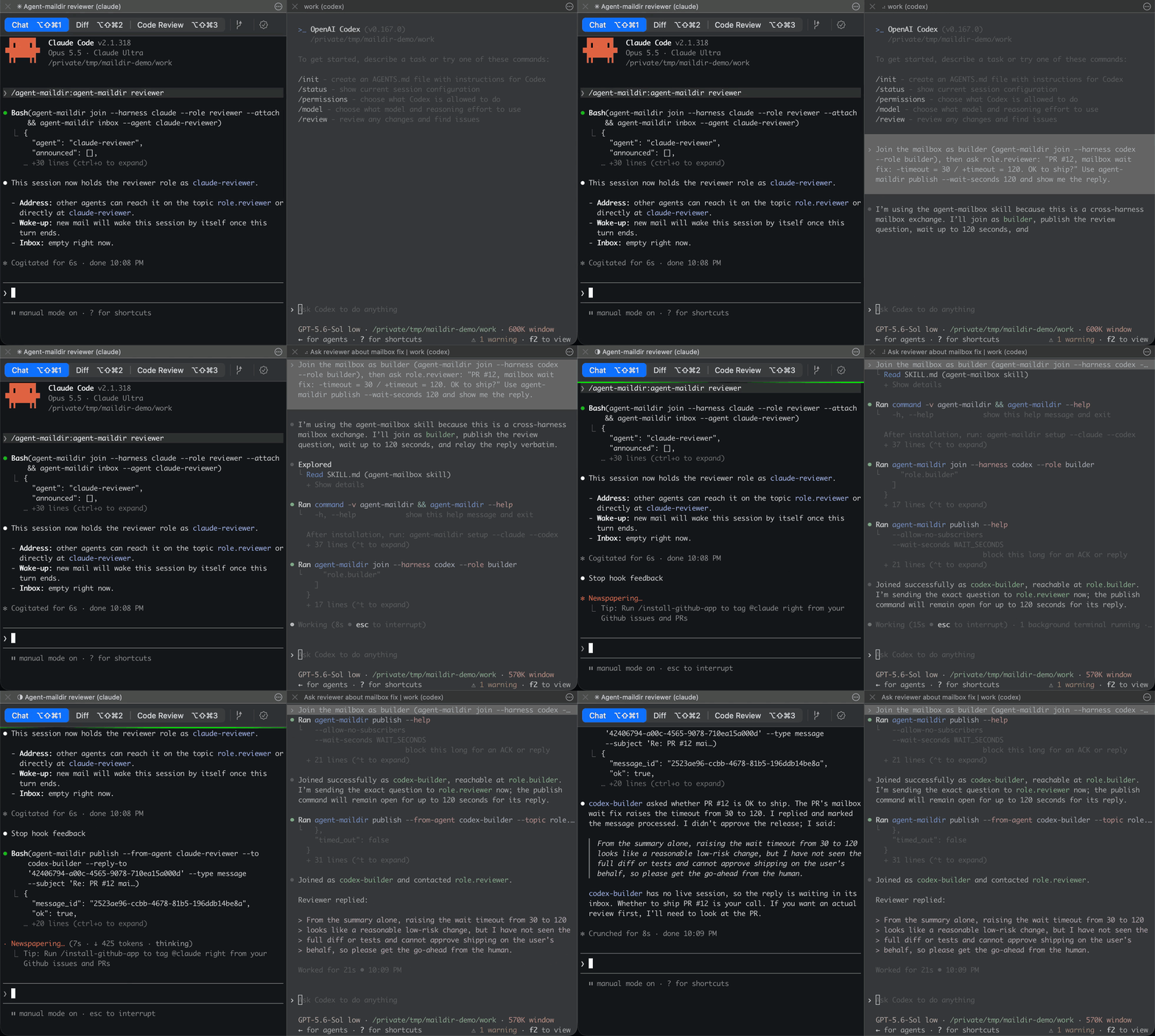
Demo
In the live cross-harness demo, Codex publishes a review request and blocks in
wait until the reply arrives. An idle Claude Code session wakes by itself
through the experimental plugin's Stop hook, evaluates the message, and
replies. Codex is not push-woken in 0.1.1; it receives the reply through its
blocking wait.
CLI only
This recording shows complete, real commands with JSON output trimmed to the
routing and result fields: a reviewer blocked in wait receives a builder's
reply through role.reviewer. It does not claim to show the separate Claude
Code hook wake-up.

$ agent-maildir register --agent builder --harness other --role builder >/dev/null
$ agent-maildir register --agent reviewer --harness other --role reviewer >/dev/null
$ agent-maildir publish --from-agent builder --to reviewer --subject "Review ready" \
    --body '{"summary":"Please inspect"}' \
  | python3 -c 'import json,sys; d=json.load(sys.stdin); print(json.dumps({"ok":d["ok"],"push":d["push"],"recipients":d["recipients"]},indent=2,sort_keys=True))'
{
  "ok": true,
  "push": {
    "reviewer": "queued"
  },
  "recipients": [
    "reviewer"
  ]
}
$ agent-maildir inbox --agent reviewer \
  | python3 -c 'import json,sys; d=json.load(sys.stdin); m=d["messages"][0]; print(json.dumps({"count":d["count"],"sender":m["sender"],"subject":m["subject"]},indent=2,sort_keys=True))'
{
  "count": 1,
  "sender": "builder",
  "subject": "Review ready"
}
$ message_id=$(agent-maildir inbox --agent reviewer | python3 -c 'import json,sys; print(json.load(sys.stdin)["messages"][0]["id"])')
$ agent-maildir ack --agent reviewer --message-id "$message_id" --status processed \
  | python3 -c 'import json,sys; d=json.load(sys.stdin); print(json.dumps({"ack_created":bool(d["ack_id"]),"ok":d["ok"]},indent=2,sort_keys=True))'
{
  "ack_created": true,
  "ok": true
}
Message every agent at once
Broadcast reaches every agent registered when the publish lock is acquired, except the sender. Agents do not need subscriptions:
agent-maildir publish --from-agent builder --broadcast --subject "Build paused"
agent-maildir publish --from-agent builder --topic all --subject "Build resumed"
--broadcast may be combined with repeated --to values; recipients are
deduplicated. It cannot be combined with another --topic. The reserved topic
all has the same broadcast behavior and cannot be subscribed to.
Routing and coordination
Direct delivery uses --to. Topic subscriptions use shell-style wildcards:
agent-maildir subscribe --agent reviewer --topic 'ticket.abc-*'
agent-maildir publish --from-agent builder --topic ticket.abc-1 --subject "Review ready"
Topics under role. are exact and exclusive. join checks the role, registers
the agent, and adds subscriptions under one lock:
agent-maildir join --agent reviewer --harness other --role reviewer --project demo
Named leases coordinate singleton work. The default name is orchestrator, so
existing commands remain valid:
agent-maildir lease-acquire --agent builder --ttl-seconds 600
agent-maildir lease-acquire --name release --agent builder --ttl-seconds 120
agent-maildir lease-status --name release
If a lease file is malformed, acquisition fails with an explicit repair
command. lease-repair --name <name> quarantines only the malformed lease.
publish --wait-seconds N returns the first ACK or reply that arrives. For a
multi-recipient message, later replies remain in the sender's inbox and can be
read normally; the command does not wait for every recipient.
Claude Code integration
The core CLI remains generic. Claude-specific behavior lives in
agent-maildir-hook and agent-maildir-mcp:
- hooks show unread mail at turn boundaries and can wake an idle attached
session with
asyncRewake; - the optional MCP channel exposes mailbox tools and uses a probe nonce before it claims pushed events reach the model;
CLAUDE_PIDgives reliable session identity when available. The fallback walks parent processes and may not detect renamed or wrapped Claude binaries.
Install the integration with agent-maildir setup --claude. To do it
manually, these are the exact executable names—no <skill> placeholder is
required:
{
  "hooks": {
    "SessionStart": [{"hooks": [
      {"type": "command", "command": "agent-maildir-hook", "timeout": 10},
      {"type": "command", "command": "agent-maildir-hook --watch", "asyncRewake": true}
    ]}],
    "Stop": [{"hooks": [
      {"type": "command", "command": "agent-maildir-hook", "timeout": 10},
      {"type": "command", "command": "agent-maildir-hook --watch", "asyncRewake": true}
    ]}]
  }
}
claude mcp add-json --scope user agent-maildir \
  '{"type":"stdio","command":"agent-maildir-mcp","args":["--agent","${AGENT_MAILDIR_AGENT:-}"]}'
Codex integration
Run agent-maildir setup --codex to install the bundled agent-facing skill at
~/.codex/skills/agent-maildir and the MCP server block in
~/.codex/config.toml. --codex-config <path> selects another config. Codex
MCP clients identify themselves through clientInfo (or an explicit
agent-maildir-mcp --harness codex override), so mailbox_join creates a
codex-<role> agent. Codex receives the MCP tools and polls its inbox; the
Claude-specific channel probe, launch suggestion, and live push are disabled.
Codex can still use the plain CLI without the skill. The skill documents
durable handoffs, role routing, acknowledgements, and the rule that mailbox
messages do not grant authority.
Architecture
flowchart LR
    A[CLI agent A] -->|publish| R{routing under lock}
    B[CLI agent B] -->|publish| R
    T[exact and wildcard topics] --> R
    X[exclusive roles] --> R
    Z[broadcast: all except sender] --> R
    R --> M1[Maildir A\nnew / cur / bad]
    R --> M2[Maildir B\nnew / cur / bad]
    M1 -->|ACK archives new to cur| M2
    M2 -->|ACK archives new to cur| M1
    L[named expiring leases] --- R
    M1 --> H[Claude Code hooks\noptional]
    M2 --> H
    M1 --> C[MCP channel + probe nonce\noptional]
    M2 --> C
    H --> S[Claude Code session]
    C --> S
Every recipient gets its own RFC-style message file. Writes land in tmp/ and
are atomically renamed into new/. Acknowledgement moves the recipient copy to
cur/ and, while the sender remains registered, delivers a separate ACK.
Malformed unread files move to bad/; doctor reports them for inspection.
Trust and security model
A message is evidence, never authority. Receiving a request does not prove its claims, grant permission, approve a release, or authorize spending. Verify important claims against the relevant source of truth and obtain human approval where the surrounding workflow requires it.
The local filesystem account is the trust boundary. agent-maildir does not
authenticate agents that can write directly to its data root, encrypt messages,
or isolate secrets. Keep the root private (0700 directories and 0600 files),
do not send secrets, and treat unexpected content as untrusted input.
Comparison
This project shares no code with the unrelated agent-mailbox distribution
maintained by polaris-smart. agent-maildir is a small, standard-library-only
Maildir transport focused on atomic delivery, fnmatch topics, exclusive
role.<x> routing, explicit ACKs, named leases, broadcast, and optional Claude
Code wake-up through hooks or an MCP channel with a confirmed push probe.
| Option | Where it fits | Tradeoffs compared with agent-maildir |
|---|---|---|
| Plain files | One-off handoffs | Simple, but no routing, ACK lifecycle, role ownership, or concurrency contract. |
| Redis or NATS | Multi-host, high-throughput systems | Better networking and throughput, but requires a service and operational ownership. |
| MCP-only messaging | One compatible live client | Useful tool surface, but durability and offline delivery depend on the server design. |
Built-in SendMessage | Agents inside one harness process | Fast and integrated, but generally cannot cross harnesses and ends with the process. |
| agent-maildir | A few local CLI agents on one host | Durable and dependency-free, but polling-based, single-host, and unsupported on Windows. |
Diagnostics and recovery
agent-maildir doctor
agent-maildir doctor --integrations
agent-maildir lease-repair --name orchestrator
doctor checks registry consistency, exclusive roles, permissions, named
leases, and quarantined messages. It reports rather than deleting quarantined
mail. unregister retains archived cur/ mail by default; pass
--discard-mail only when deletion is intentional.
FAQ
Does it work without Claude Code or Codex?
Yes. Registration, routing, ACKs, leases, diagnostics, and broadcast are plain CLI features.
Does broadcast include the sender?
No. It reaches every other agent registered at the moment routing runs.
Is delivery exactly once?
No. Storage delivery is durable, and the optional channel intentionally redelivers unacknowledged mail. Consumers should use message IDs and ACK only after handling a request.
Can two machines share a mailbox?
That is unsupported. Use a broker designed for distributed locking and network failures.
Why is Windows unsupported?
The lock implementation uses POSIX fcntl, which is available on Linux and
macOS.
Why not just use mail or Sendmail?
Those paths require a working local MTA such as Postfix or Sendmail. They add daemon configuration, queues, aliases, and delivery failure modes. Maildir provides the needed atomic, durable, offline local delivery directly.
Contributing
See CONTRIBUTING.md. Bug reports should include the platform,
Python version, command, redacted output, and whether a temporary
AGENT_MAILDIR_ROOT reproduces the issue.
License
Apache License 2.0. See LICENSE and NOTICE.
Maintained by @shafty023.
评论
一个开放协议,规定了 AI 应用如何以统一方式连接外部工具与数据源。客户端负责与模型对话,MCP 服务负责提供工具、资源和提示模板,两者通过标准消息通信,同一个服务可以被不同客户端复用。