
Where MCP comes from: a shared protocol for connecting AI models to external tools
Large language models excel at understanding and generating content, but they do not inherently know the latest internal enterprise data, nor can they directly operate every type of software. To let models retrieve information, read files, or perform actions, developers typically need to connect models to external systems one by one: each tool has its own interface, authentication method, and data format, while each model or client has different integration requirements. Model Context Protocol (MCP) aims to solve precisely this kind of connectivity problem.
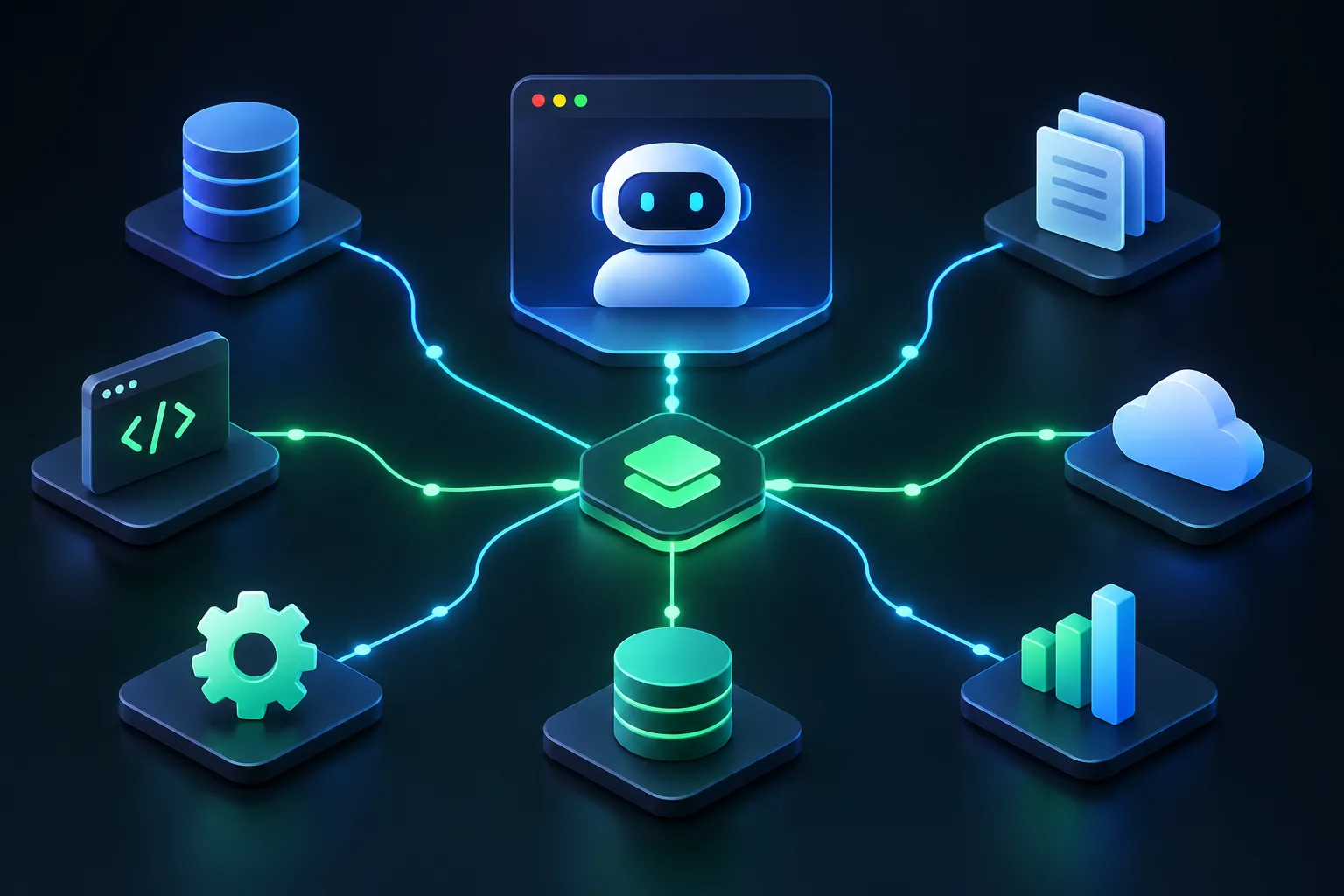
MCP is an open protocol that defines how AI applications discover and invoke external capabilities. It divides participants into clients and servers: clients interact with models and users, while servers provide data or functionality externally. Servers can expose capabilities such as tools, resources, and prompts; clients discover these capabilities through a unified interaction method and invoke them when needed. The protocol itself does not make models smarter or replace specific tools; instead, it adds a shared set of conventions between model applications and tools.
This relationship can be understood as a “universal interface”: tool developers provide capabilities according to the protocol, and client developers integrate them according to the protocol. Neither side has to design a dedicated connection from scratch for every combination, shifting the focus of integration work from repeatedly adapting formats to designing capabilities, managing permissions, and improving the user experience.
From early exploration to ecosystem growth: the development of MCP
Anthropic introduced MCP in 2024. Its arrival addressed an increasingly clear engineering reality: model capabilities are advancing rapidly, but whether models can effectively contribute to real-world work often depends on their ability to access context and tools safely and reliably. Writing connectors separately for each application can meet immediate needs, but it also leads to duplicated implementations, maintenance costs, and compatibility problems.
After the protocol was introduced, developers began building server-side and client-side implementations around a unified connection method. Data sources and tools that had been scattered across different products gradually gained the potential to connect to AI applications through the same type of protocol. Ecosystem growth means more than just “more tools to call”: development frameworks, clients, deployment methods, permission management, and debugging practices all affect whether the protocol can truly become part of everyday development.
This development reflects a typical path for infrastructure: first solve the connectivity problem, then refine engineering details based on implementation and user feedback. The protocol's value ultimately depends not on its name or concept, but on whether it makes building easier for developers, makes things easier for users to understand, and enables organizations to manage risk.
Why compare it to CUDA: how a unified interface lowers integration costs
The core of comparing MCP to CUDA in the field of AI tool connectivity is that both emphasize the ecosystem effects of a shared interface. CUDA provides developers with a programming platform for GPU computing, allowing software to use specific hardware capabilities in a relatively consistent way. MCP, in turn, aims to provide a shared protocol for model applications to connect to external tools and context, enabling different clients and servers to work together using similar interaction conventions.
The comparison is illuminating, but the two should not be treated as equivalent. CUDA targets specific computing hardware and its software stack; MCP targets communication and integration between model applications and external capabilities. It does not automatically guarantee service availability, data correctness, or safe operations, nor does it make all tools seamlessly compatible. Its real-world effectiveness depends on the quality of protocol implementations, the clarity of capability descriptions, and whether clients provide appropriate authorization and feedback.
A unified interface lowers costs in three main ways:
- Reduces repeated adaptation: Servers can provide capabilities according to the protocol, and multiple protocol-supporting clients may be able to reuse the same implementation.
- Lowers migration barriers: When applications or tools change, teams do not always have to design dedicated connections from scratch.
- Encourages capability composition: Tools and context from different sources can work together in the same workflow, making it easier for developers to focus on the task itself.
MCP's value, then, is not that “one protocol solves all integration problems,” but that it makes the conventions previously implicit in various connectors explicit, providing a more consistent starting point for ecosystem collaboration.
Bringing MCP into everyday work: changes in efficiency and collaboration
In practice, MCP's benefits usually do not come from a single feature, but from reducing friction when connecting AI applications to work systems. For example, developers can let a model read project materials, query internal data, or call specific tools to complete tasks once authorization has been granted. Processes that previously required switching between multiple systems and copying information may become a seamless interaction.
For application development teams, protocol-based connections can relatively decouple tool capability development from the model interface. Teams responsible for data or business systems can maintain server capabilities, while teams responsible for clients can focus on model interactions, user confirmations, and presenting results. Clear boundaries support division of responsibilities and make testing and troubleshooting easier.
For users, the key benefit is that context can more easily enter workflows. Models no longer have to rely solely on information manually pasted by users; they can access the content they need within the scope of authorization. However, this does not mean that all work should be automated by models. Queries, summaries, and suggestions are generally lower risk; actions such as sending messages, editing records, or deleting data should have confirmation, permission, and audit mechanisms in place.

When rolling MCP out, teams can start with clearly bounded, low-risk scenarios: first connect read-only data or reversible operations, observe whether calls are accurate and permissions behave as expected, then expand gradually. Teams should also define standards for tool descriptions, error handling, timeouts, logging, and secret management. This is how “it connects” becomes “it is maintainable and governable.”
Future trends and challenges: ecosystem maturity, security governance, and standard evolution
MCP's future trends will first depend on whether its ecosystem can move from early adoption to stable collaboration. As more client and server implementations emerge, developers will pay closer attention to compatibility, observability, deployment experience, and cross-environment management. Maturing the protocol means not only increasing the number of capabilities, but also making them easier to discover, understand, test, and update.
Security governance will be another major focus. Tool calls may access sensitive data or have real business impact, so read and write permissions need to be clearly distinguished, accessible scope must be limited, and users should know what actions the model is about to perform. Trusted server sources, identity authentication, secret protection, call auditing, and incident response also cannot be replaced by the protocol itself. Organizations must also assess the risks of third-party capabilities and avoid mistaking “supports MCP” for “inherently trustworthy.”
The evolution of standards will need to balance consistency with flexibility: too few conventions lead to insufficient interoperability; too many can increase implementation burdens. Future practice will continue to test whether capability descriptions, authorization flows, and error semantics are clear enough, and will also encourage developers to adopt more mature security and operations practices.
Whether MCP can become the foundational layer for AI tool connectivity still depends on ecosystem adoption, implementation quality, and governance capabilities. For teams, the right next step is not to connect every tool indiscriminately, but to pilot a low-risk, high-frequency workflow, validate the efficiency gains and security boundaries, and then decide how to expand.